
Two stories came out of China this month, eleven days apart. The largest open-weight model ever released, and a national plan to teach AI in every primary and secondary school by 2030. The classroom half deserves more of your attention than the model half.
Two stories came out of China this month, eleven days apart. Most of the coverage treated them separately, but they're really one story.
On 17 July, Moonshot AI, a Beijing lab backed by Alibaba, Tencent and Meituan, released Kimi K3. Fortune calls it the largest open-weight model ever made public, which in plain language means anyone, anywhere, can download it and run it. Then on 28 July, researchers at Georgetown published the first full English translation of the document that explains what China wants its schools to do about tools like this: the Ministry of Education's plan for AI education in every primary and secondary school.
So on one side you've got the tools, and on the other you've got the people who'll be using them. China is building both at the same time, and honestly, the school half deserves more of your attention than the model half.
The model is one half.
Let's do the numbers. Moonshot charges fifteen dollars per million output tokens. Anthropic lists Fable 5 at fifty. That comparison comes from Fortune, and so does this one: Moonshot says K3 competes with the best models in the world, and one independent leaderboard, Arena.AI, ranked it first. I'd take the capability claims with a pinch of salt, because benchmarks from the company that built the thing always need one. But the price is real, and the markets took it seriously. Fortune reports TSMC fell seven per cent in a day, SoftBank fell nine, and Nvidia briefly stopped being the world's most valuable company. Fortune's Nicholas Gordon called it a possible second DeepSeek shock.
And it isn't a one-off. DeepSeek V4 arrived in April at under a dollar per million tokens, per Fortune, which also reports that the five most-used models on OpenRouter are all Chinese, that DoorDash pushes routine work to Kimi at better quality and lower cost, and that Cursor built its Composer 2 agent on Kimi 2.5.
Here's what that means for your school. Models this good and this cheap are going to end up inside the edtech products you already buy, simply because they're cheaper for the companies building those products. Nobody in your building will have chosen them.
The classroom is the other half.
Now the school mandate, and it's worth getting the dates straight.
The plan isn't new. China's Ministry of Education published it back in December 2024, and it set the target that matters: AI education "basically universal" in every primary and secondary school by 2030. What actually happened on 28 July is that Georgetown's CSET translated the whole thing into English, eleven days after the country that wrote it shipped the world's biggest open model. That's why it's all over your feeds this week.
The timetable is real, but it is local rather than national. Beijing and Tianjin both started in the autumn 2025 term. China Daily reports more than fourteen hundred Beijing schools running no fewer than eight class hours a year, and Xinhua reports Tianjin making one AI class a week compulsory in the fourth and eighth grades, with Hangzhou, Xi'an and Chongqing following. Nationally there is no single start line, only the 2030 date. And in April, five government departments together launched an "AI plus Education" plan running to 2030, which, per CGTN, also puts AI into the exams teachers sit to qualify.
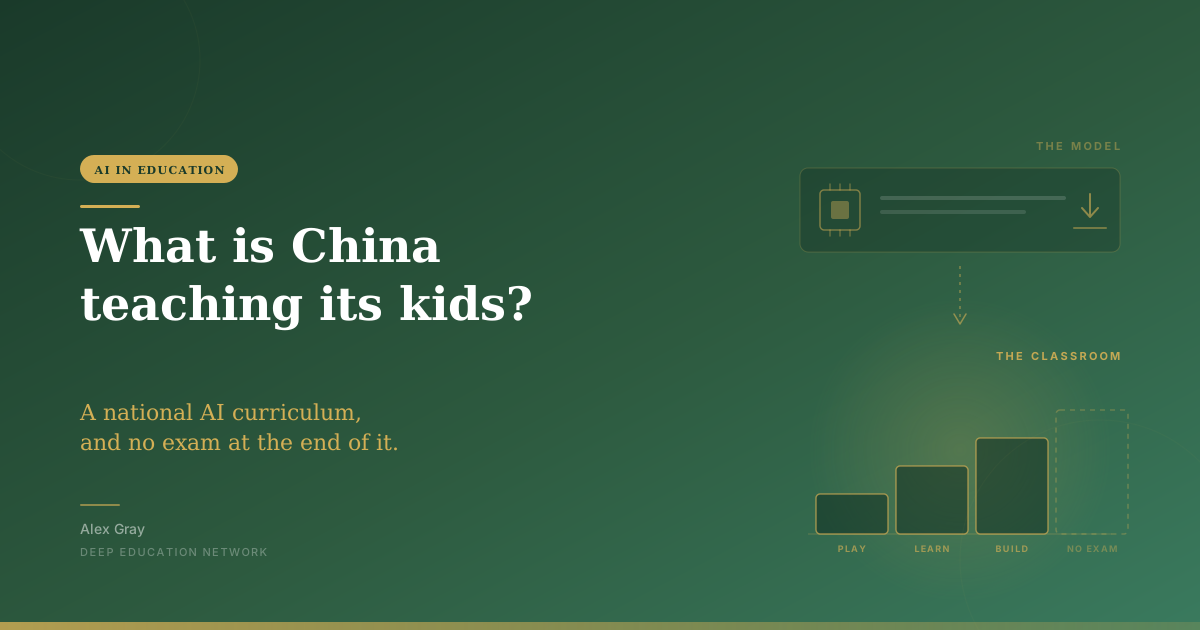
The design itself is tiered by age, and it's simple. Little kids play with AI and get a feel for it. Middle schoolers learn how it works and start using it properly. By high school, students are building creative projects with advanced tools.
China's the second country to do this, by the way. The UAE got there first, announcing in May 2025 that AI would run from kindergarten to Grade 12 in public schools, per Gulf Business. So that's two school systems now treating AI literacy the way they treat reading.
The best bit is what isn't in it.
There's no exam. The notice sets up a curriculum, teaching, resources, teacher supply and funding, and never attaches a test to any of it. On assessment it asks schools to "emphasize the evaluation of innovative thinking, practical abilities, and related competencies". Sina reported at the time that the notice didn't address whether AI would go into the zhongkao or the gaokao, proposing only to explore AI literacy inside the comprehensive quality evaluation system. Think about who's saying that. This is the country that runs the gaokao, the national university entrance exam, and it's built a curriculum without an exam on the end of it.
Why? The honest reading is that nobody, including the people who wrote the mandate, can define what "good at AI" means yet, so there's nothing solid to test. Better to let kids play, build and create for four years, and work out what mastery looks like along the way. I say this all the time: pedagogy should lead and policy should follow. It's rare to see a ministry actually write it down.
Will it hold? Honestly, who knows. China's exam culture is ferocious, and you can already imagine a private tutoring market in "AI readiness" growing in the gap the ministry left. A good plan can still go wrong in the rollout, and we won't know for four years.
So what do you do with this, sat in a school nowhere near Beijing?
Two things, and neither needs you to hold an opinion about China.
First, procurement. If cheap open models are coming into your tools anyway, the questions worth asking are the ones I set out in the Library earlier this month: which model actually runs inside each product, where does student data go, and under whose laws? Ask at renewal, and ask in writing. A vendor who can't answer has answered.
Second, curriculum. There are now two national curriculum designs you can borrow from, and borrowing is free. The order China has settled on is the useful bit: kids use AI first, then learn how it works, then make things with it, and nobody has built an exam for it yet. Worth knowing: China is also putting AI into its teacher qualification exams, which answers the question of who teaches all this. You'll have to answer that one yourself. But a head of department could still sketch a first version for their subject this term, without waiting for anyone.
The argument in one sentence. China has decided AI literacy is infrastructure and is building the models and the students on the same timetable; the useful response is to read the design, borrow the sequence, and know what's running inside your own tools.
If you want to know where your school actually stands before you write anything, the free DEEP AI Literacy Audit takes fifteen minutes: audit.deepeducationnetwork.com.
China's biggest cities started teaching this last year. Your students are already using it.
Corrected 31 July 2026. This piece originally cited The Silicon Review for two claims: that the ministry had ruled out standardised AI testing before 2030, and that schools could not use AI courses as a selling point for admissions. Neither appears in the primary document, and the outlet was the wrong one to lean on. The notice does not ban an exam. It declines to create one, and points AI literacy towards comprehensive quality evaluation instead.
Sources
- Ministry of Education of the People's Republic of China, 教育部部署加强中小学人工智能教育 (Notice on strengthening AI education in primary and secondary schools), 2 December 2024
- Center for Security and Emerging Technology, Georgetown University, Notice of the Office of the Ministry of Education on Strengthening Artificial Intelligence Education in Primary and Secondary Schools (full translation), 28 July 2026
- Nicholas Gordon, Markets may have just experienced their second DeepSeek shock, Fortune, 17 July 2026
- Sina Finance, 会不会纳入中高考?教育部发文加强中小学人工智能教育, 6 December 2024
- China Daily, Beijing makes AI education compulsory in public schools, 21 October 2025
- Xinhua, Yearender-China Focus: AI takes root in basic education, nurturing future innovators, 24 December 2025
- CGTN, China to include AI in teacher exams and transform education system, 10 April 2026
- Gulf Business, UAE schools to introduce AI curriculum from KG to grade 12, May 2025
Photograph: jason hu on Unsplash.

Stay in the Loop
Get practical insights about AI in education, new articles, and training updates delivered to your inbox.
No spam. Unsubscribe anytime.
Work With Alex
Looking for hands-on support with AI integration, curriculum design, or teacher professional development? Alex works with schools and organisations worldwide to build practical, evidence-informed approaches to education technology.