
Three frontier labs shipped three major model revisions in one spring. If a single release can send your staff scrambling to switch tools, what you had was never a strategy — it was a preference. Here is the argument for teaching the muscle, not the machine.
The model you standardised on is already old
A few of the groups I sit in have started talking about moving back from Claude to ChatGPT. Six months ago the same groups were moving the other way. The model they had built around shipped a new version, a competitor leapfrogged it on a benchmark someone shared in a thread, and the conversation turned to switching.
Here is the uncomfortable bit. If a single release can send a whole community scrambling to change tools, what you had was never a strategy. It was a preference. And a preference does not survive contact with a release cycle moving this fast.
The compression is real, and it is recent
This is not a vibe. Look at what shipped in a single spring.
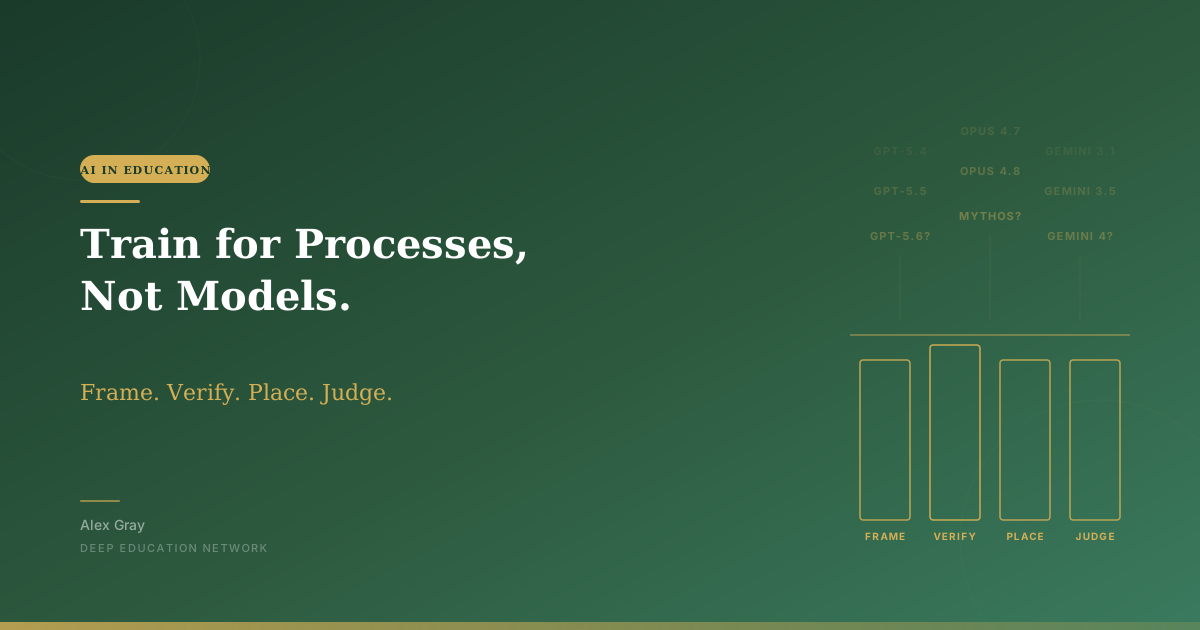
OpenAI released GPT-5.4 on 5 March 2026. GPT-5.5 followed on 23 April, roughly seven weeks later, and by 5 May the new Instant model had become the default for everyone. Anthropic released Claude Opus 4.7 on 16 April and Opus 4.8 about six weeks after that, while its Mythos-class systems sit just over the horizon, promised "in the coming weeks." Google put Gemini 3.1 Pro out on 19 February, then layered 3.1 Flash-Lite and a generally available 3.5 Flash on top within weeks.
Three frontier labs, three major revisions, one season. The gap between releases used to be measured in years. Now it is measured in weeks, and each lab is reacting to the others in close to real time. We have moved from annual upgrades to a rolling cycle where the leaderboard reshuffles before most schools have finished writing the training slides for the last model.
So the instinct to chase the best model is rational and also a trap. The best model is a moving target by design. Whichever one you name today, name it in pencil.
Why this breaks the usual school approach
Most institutions did the sensible-looking thing. They picked a tool, bought a licence, ran the twilight session, built a shared prompt library, and told staff "this is the one we use." That made sense in a world of slow releases. It makes you fragile in this one.
When the model changes underneath you, and it now changes every few weeks, three things happen. The prompt library tuned to one model's quirks stops behaving the way the examples promised. The staff who were trained to trust a specific tool feel the ground shift and lose confidence. And the leaders who committed budget to a single vendor discover that the thing they bought for its capability edge no longer holds that edge.
The reaction to all of this is usually to switch. Move back to ChatGPT. Move across to Gemini. But switching does not solve the problem. It restarts the cycle. You retrain everyone on the new tool, rebuild the library against the new quirks, and wait for the next release to do it to you again. You are not building capability. You are paying a tax, over and over, on a decision you keep having to remake. The cleanest version of this argument I have made before is in Why Smart Schools Are Ditching EdTech Subscriptions; this piece is the next step of it.
The reframe: train the muscle, not the machine
The way out is to stop teaching the tool and start teaching the work.
Almost everything that makes someone genuinely good with AI transfers across every model. None of it depends on which logo is in the corner of the screen. Strip a confident, capable AI user down to what they actually do, and you find a set of habits that GPT-5.5, Opus 4.8 and Gemini 3.1 all reward in exactly the same way.
They frame the task properly. They can take a vague request and break it into something a model can act on, with the context and constraints made explicit. This is decomposition, and we already teach it in every subject in the building.
They verify before they trust. They treat every output as a draft to be checked against a standard they hold, not an answer to be accepted. The verification reflex is the single most important AI skill, and it is completely model-independent. A hallucination from a frontier model is still a hallucination.
They know where the AI sits in the work. The value is not in the output, it is in the decision the output feeds. AI produces impact when it is built into the moment a decision is actually made, in the right format and at the right time, and stalls when it is bolted on beside a workflow rather than into it. That judgement about placement is a human skill, and it does not expire when a new model ships.
They evaluate against a rubric, not a feeling. Does this meet the standard, yes or no? That question is the same whoever answered it.
These are processes. They are also, not by coincidence, the things we have always taught well: break the problem down, model the thinking, check the work, judge against a clear standard. The pedagogy we already trust maps almost perfectly onto AI capability. We just have to point it at the right object.
What this looks like on the ground
Practically, it means a few shifts in how a school builds AI literacy.
Build a capability framework, not a tool manual. Train staff and students on the process of working with any model, then let the specific tool be interchangeable. The framework outlives the model. The manual does not. I wrote a longer piece on what the global picture of those frameworks looks like in What 33 International Frameworks Say About AI in Schools.
Teach the verification reflex first and loudest. Before anyone learns a clever prompt, they should learn the habit of checking. If a model changes and people still verify, you have lost nothing. If they were only trained to trust the old tool, you have lost everything.
Treat models as engines, not identities. The question is never "are we a Claude school or a ChatGPT school." It is "what is the task, what is the risk, and what is the budget," and then you slot in whichever engine fits. Pick by task, not by allegiance.
Anchor it to something stable. This is why we built the DEEP AI Literacy Audit around nine fixed dimensions rather than around any one platform. The dimensions do not move when the models do. They give you a way to measure capability that is still valid after the next release, and the one after that. The nine questions sitting behind it are laid out in full in Is Your School AI-Ready? The 9 Questions Every Headteacher Must Be Able to Answer.
The strategic point
Building a strategy around a single model is fragile by design, and you have just watched a season of releases prove it. The labs are not going to slow down for you. The cadence we saw this spring is the new normal, not a blip.
So stop optimising for the model. Optimise for the muscle. The institutions that win the next two years will not be the ones who picked the right tool in 2026. They will be the ones who taught their people to work well with any tool, and who therefore stopped flinching every time a new one arrives. The release cycle compressed. Your strategy should not have to.
If you want to know where your school actually stands on this, the DEEP AI Literacy Audit measures capability across nine dimensions that hold steady regardless of which model is on top this month. And for more on how humans learn and how we get better, including the thinking behind process over tools, find The DEN on YouTube.
Frequently asked
How fast are frontier AI models actually releasing in 2026? Faster than any school's training cycle can absorb. In a single spring, OpenAI shipped GPT-5.4 and GPT-5.5, Anthropic shipped Opus 4.7 and 4.8, and Google shipped Gemini 3.1 Pro followed by 3.1 Flash-Lite and 3.5 Flash. Three labs, three major revisions, one season. The gap between major releases has compressed from years to weeks.
Why is picking a single AI model a fragile strategy? Because the moment you standardise on one tool, you are betting that the model behind it will still be the right choice three months from now. With release cycles measured in weeks, that bet rarely holds. Your prompt library degrades, staff confidence wobbles when behaviour shifts, and the procurement decision quietly stops making sense. Switching tools does not solve this — it just restarts the cycle.
What are the model-independent AI skills schools should actually teach? Four, in order. Framing — decomposing a vague task into something a model can act on. Verification — treating every output as a draft to be checked, not an answer to be accepted. Placement — knowing where in a workflow the AI belongs and where human judgement has to stay. Evaluation — judging the output against a rubric, not a feeling. These transfer across every model and every release.
What is the DEEP AI Literacy Audit and how does it help? It is a school-level audit that measures AI capability across nine fixed dimensions rather than against any one platform. The dimensions stay valid as models change, so you get a measure of your school's underlying readiness that does not need rewriting every time a lab ships an update. The nine questions sitting behind it are explained in Is Your School AI-Ready? and the audit itself is at audit.deepeducationnetwork.com.
How is this different from your other pieces on AI strategy in schools? AI Is Not an IT Problem argued that AI literacy cannot live in one department. The Pastoral Side of AI argued that the next strategic move is academic-pastoral integration. This piece picks up the timing question both of those leave open: what to do when the underlying technology is changing faster than any institution can retrain around it. The short answer is that the what of AI strategy in school no longer changes with each release. The how — process over tool — is what gives you a strategy that holds.
Filed under

Stay in the Loop
Get practical insights about AI in education, new articles, and training updates delivered to your inbox.
No spam. Unsubscribe anytime.
Work With Alex
Looking for hands-on support with AI integration, curriculum design, or teacher professional development? Alex works with schools and organisations worldwide to build practical, evidence-informed approaches to education technology.