
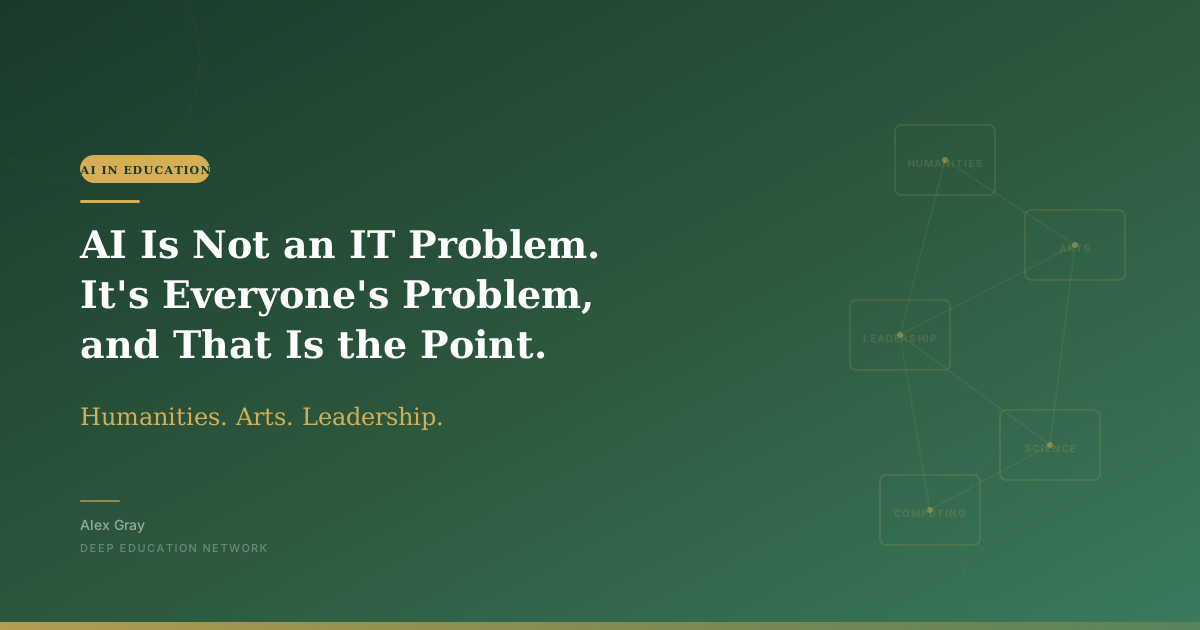
Filing AI under 'computing' is the most dangerous structural mistake a school can make right now. Three reasons AI literacy has to live across humanities, leadership, and the arts — not just the IT suite.
AI is not just tech, and the schools treating it that way are leaving everyone defenceless
I teach secondary science. I also lead digital learning and AI across a British international school, which means a good chunk of my week is spent in conversations about where AI belongs in the building. There is a default answer that surfaces again and again, almost always with the best of intentions: give it to the computing team. They understand the technology. Let them own it.
I understand the instinct. For thirty years that is exactly how schools handled anything with a plug. If the network went down you called IT. If a child needed to know how a computer worked you sent them to the computing room. Technology was a place you went to and a skill set you opted into. The barrier was the point. It let us draw a clear line between the digital world and everything else.
That line has gone, and the people still drawing it are the ones I worry about most.
AI is not a faster spreadsheet or a sleeker word processor. When the ledger became a spreadsheet the maths stayed the same and the speed changed. AI is not that. It changes how people think, what they trust, and how they decide what is true. Filing it under computing is not a tidy bit of timetabling. It is a category error, and it leaves the rest of the school, and the rest of the world, without the literacy it now needs.
Here are the three reasons I have stopped accepting "it's a tech thing" as an answer.
It is a human and ethical shift, not an IT ticket
Old digital literacy was functional. You learned the tool. Keyboard shortcuts, how a file saved, the syntax of a language. The questions had right answers and the answers lived in the computing curriculum.
AI breaks that model because the hard questions it raises are not technical at all.
For the first time we are working alongside technology that does not just process what we give it. It generates. It drafts the policy, writes the prose, builds the working app from a sentence of plain English. That moves the conversation out of computing and straight into the territory of human agency, ownership and identity. If a model can produce a passable version of a student's essay in seconds, the question "what is this child's work actually for" is not a coding question. It is a question about purpose, and it belongs to every teacher in the school.
There is a second shift that worries me more, because it is quieter. When a student used a search engine, the cognitive job was retrieval. Find the source, judge it, synthesise it. The text on the page was fixed and somebody had written it. When that same student talks to a large language model, the job changes entirely. They are now evaluating a system that speaks with total confidence, flawless grammar and a persuasive rhythm, whether or not a word of it is true.
Spotting a hallucination or a baked-in bias is not a computing skill. A student does not need Python to notice that a model has quietly flattened a contested bit of history into a single confident paragraph. They need the things we teach in humanities and the arts: source criticism, historical context, an ear for how language builds a narrative and hides its own gaps. If we leave AI entirely to the specialists, we end up with a generation that can explain how the model is trained and has no defence at all against what it says. It is the same structural failure that makes most AI policies fail in practice: the right document in the wrong hands changes nothing.
The barrier to entry has disappeared
The second reason is the one schools are slowest to accept, because it removes a lever we have leaned on for years.
For the whole digital age, getting online took deliberate effort. Walk to the machine, boot it up, open the browser, log in. That friction was useful. It let parents supervise the computer in the corner of the room and let schools lock down the IT suite. You knew when you were using technology and when you were not.
That friction has gone. AI is no longer a destination you visit. It is the air the tools breathe.
Type a question into Google now and an AI generated answer often sits above the links, written for you before you have clicked anything. The predictive models are built into the search bar, the operating system, the email client, the messaging app. Nobody opens "the AI". It is simply running underneath the things they were already doing.
This matters enormously for who needs to be literate. If a school blocks three named AI apps but the default search on every device answers in a generative chat, the block achieves very little. A six year old looking up a science fact is no longer reading a static page. They are in conversation with a system that shapes its reply on the fly, and nothing on the screen asks their age first. At the other end, a pensioner managing their banking and medical records online is being handed AI generated summaries whether they recognise it or not.
So the comfortable idea that AI literacy is an optional extra for the tech-minded is finished. When deepfakes, automated scams and synthetic text are woven into the basic infrastructure everyone uses, knowing how to read that landscape critically is not a specialism. It is a survival skill, and it has to reach from the youngest child in the school to the oldest person in the community.
The more capable the machine, the more the human matters
Here is the part I find genuinely hopeful, and it is the part the doom-laden version of this argument tends to miss.
The better AI gets at imitating us, the more valuable the things it cannot do become. Once a model can produce a competent essay, a usable image or working code in seconds, the market value of that mechanical output falls towards zero. What rises in value is everything sitting around it. The judgement. The taste. The decision about whether the output is any good and whether it should exist at all. The core skill of this era is not optimisation. It is discernment.
A model is brilliant at optimisation. It will analyse a student's data and assemble a mathematically efficient sequence of revision. It will scan a budget and tell you exactly where to cut. What it cannot do is read a room. When I am teaching and a child is quietly struggling, the data tells me they got the last three questions wrong. It does not tell me they had a rough morning at home, or that the dimming in their face means I should drop the planned sequence and rebuild their confidence first. A tutoring system tracks the wrong answers. A teacher reads the posture. The learning happens because the child felt seen, and that is the bedrock of the job, not a nice extra on top of it.
I heard the same point made from the other direction at our conference this year. When students were asked about teachers using AI to plan lessons and write feedback, the thing that came through was not the technology. It was the relationship. They valued knowing a human had thought about them. The model can draft the comment. It cannot mean it.
Using AI well means staying in the driver's seat rather than becoming a passenger in an automated world. Every output a model gives you is a kind of average of historical human data. It has no perspective and no conviction. The human job is to pass it through a filter the machine does not have, and to keep asking the questions it cannot ask itself. Is this honest. Does it hold someone's dignity. Does it fit the actual community in front of me, not a statistical idea of one. How will the person on the receiving end feel.
If we treat AI as just tech, we treat its output the way we treat a calculator's. The computer said it, so it must be right. That passivity is how bias gets laundered into policy and how a school slowly stops thinking for itself. The alternative is to teach people to treat AI output as raw material that still needs human editing, ethical auditing and a human's lived experience to finish it.
Pull it out of the computing lab
Treating AI as an IT issue is one of the more dangerous structural mistakes a school can make right now, because it quietly hands the most important conversation of the decade to the smallest group of people in the building.
AI is changing how we form beliefs, how we check what is real, how we teach and how we lead. That is not a job for the network manager. International frameworks across more than thirty education systems increasingly agree on this point: AI literacy is a whole-school responsibility. It belongs in the humanities, taught through ethics and history. It belongs in the arts, explored through creativity and human expression. It belongs with leaders, lived out through pastoral care and the culture they set. The computing team has a real and important part to play. They do not get to carry it alone.
We spent a long time teaching people to think more like machines. The work now is the opposite. Protect and grow the things that make us human, and treat the machine as a tool we keep firmly in our hands.
If you want to know where your own school actually sits on this, that is the question the DEEP AI Literacy Audit exists to answer. It scores you across the dimensions that matter and hands back a plan rather than a verdict. The first audit is free, and it is a more honest starting point than a hunch about whether AI is "covered" because it lives on someone's timetable.
Frequently asked
Why shouldn't AI live with the IT or computing department? Because the questions AI raises are not technical. They are about human agency, source criticism, ethics and judgement — work that belongs in humanities, the arts, and school leadership. The computing team has a real role to play, but cannot carry the literacy alone. Filing AI under computing is a category error that leaves the rest of the school without the literacy it now needs.
Who needs AI literacy in a school? Everyone. AI is now embedded in search, email, operating systems and messaging apps. Six-year-olds and pensioners interact with generative systems without realising it. AI literacy has stopped being a specialism and become a survival skill that has to reach from the youngest child in the school to the oldest person in the community.
What does AI literacy actually mean if it isn't a coding skill? It is the ability to recognise when AI is shaping what you read, judge whether the output is trustworthy, and apply human discernment — ethical, contextual, relational — to anything the machine produces. It draws on source criticism, historical context, and an ear for how language builds a narrative and hides its own gaps. Those are humanities and arts skills, not computing skills.
How does a school know if it is treating AI as a tech problem? If AI sits on one person's timetable, lives only in the IT policy, or is "covered" because the computing team teaches it, the answer is yes. A more honest test is whether humanities, arts, and leadership teams are actively shaping how AI is used in classrooms. The DEEP AI Literacy Audit scores schools across the dimensions that actually matter.
Filed under

Stay in the Loop
Get practical insights about AI in education, new articles, and training updates delivered to your inbox.
No spam. Unsubscribe anytime.
Work With Alex
Looking for hands-on support with AI integration, curriculum design, or teacher professional development? Alex works with schools and organisations worldwide to build practical, evidence-informed approaches to education technology.