
ChatGPT for Teens is a better default for young people. Schools should still treat its safety claims as untested until independent evidence arrives.
ChatGPT for Teens started rolling out globally on 18 August. That means this is no longer a product announcement for schools to note for later. It is already landing on the personal accounts of students sitting in our classrooms.
OpenAI has made several sensible changes. Teen accounts get stronger content safeguards, learning tools, break reminders and optional parental controls. A new Responsible Homework Reminder is meant to notice when a student is trying to avoid the work and steer them towards step-by-step help instead.
I am glad these protections exist.
I am not ready to call the product safe.
The question schools are likely to ask is whether ChatGPT for Teens solves the risk of young people using a general chatbot. It is too early to answer that. The more useful question is which protections work when a teenager is bored, upset, determined or simply using the product outside the account OpenAI thinks belongs to them.
What has actually launched
OpenAI says it designed ChatGPT for Teens for users aged thirteen to seventeen. It is not a separate app. If account information, verified age or OpenAI's age prediction indicates that somebody is under eighteen, the teen experience switches on automatically.
The global rollout covers eligible Free and paid personal accounts, although availability is still expanding and Australia is due to reach full availability on 8 September.
For learning, teens can use Study Mode, quizzes, learning visualisations and Study Hours. The homework reminder may suggest Study Mode when it detects a shortcut. Under OpenAI's parental controls, parents who link their account can set quiet hours, turn off voice, memory or image generation, and receive alerts in a limited set of high-risk situations. OpenAI has added eating-disorder notifications alongside existing alerts concerning self-harm.
The model is also instructed to keep clearer relational boundaries. OpenAI's launch announcement says ChatGPT should not use romantic language, encourage emotional dependence or claim to have feelings or consciousness.
This gives a fourteen-year-old a safer default than the standard experience, although its performance still needs independent testing.
The independent test matters more than the launch post
Common Sense Media's Youth AI Safety Institute has said it will publish an independent risk assessment in the weeks ahead. The planned tests focus on the right places.
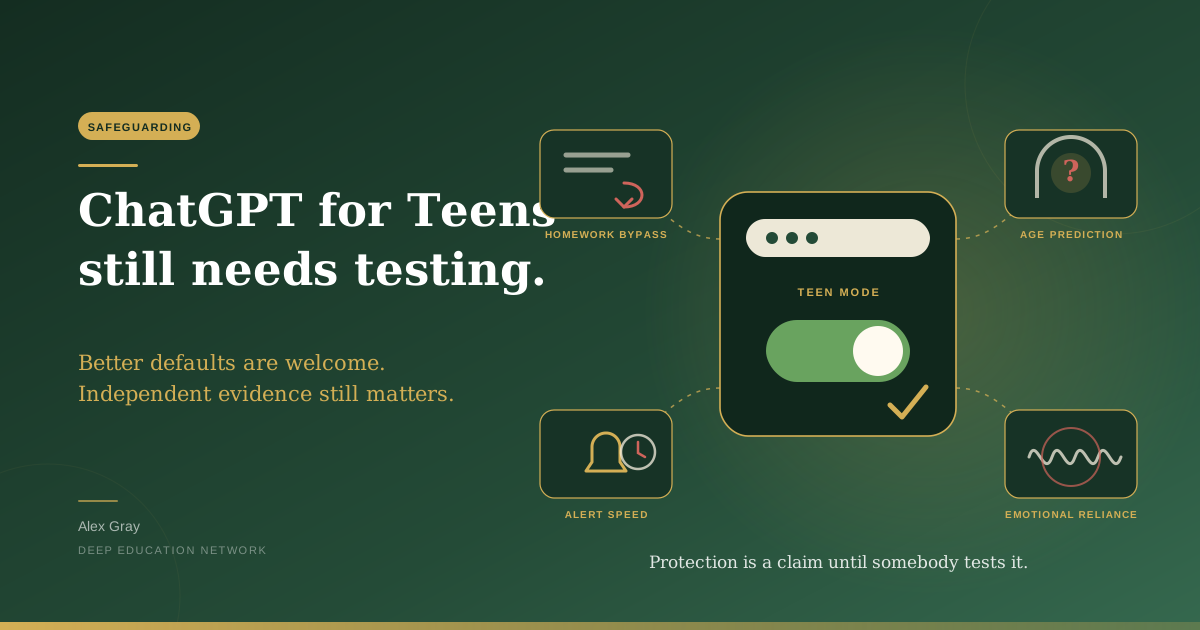
First, can a student bypass the Responsible Homework Reminder? They might persist in the same conversation, open another mode or use a logged-out session. If the reminder only works when a student accepts the first refusal, it is a prompt towards better behaviour. It is not a dependable learning control.
Second, how reliably does OpenAI recognise teenagers? Its system can use account details and behavioural signals to predict age, and OpenAI says it will apply teen protections when uncertain. Yet its own age-prediction update says the EU rollout only began on 25 August. Common Sense Media wants to know how reliably the system handles false ages and logged-out users.
Third, do parental alerts arrive quickly enough? This is not a minor service measure. In its previous ChatGPT-5 assessment, Common Sense Media rated the product High Risk overall and said alerts in its testing frequently arrived more than twenty-four hours later. Its separate assessment rated AI chatbots used for mental health support as Unacceptable Risk.
OpenAI's new protections may perform better, but independent testing has to show that.
The fourth issue is quieter and may matter most. Teenagers can adjust the voice and make the assistant warmer, friendlier or more enthusiastic. OpenAI says personalisation should not blur the line between a useful tool and a human relationship. Common Sense Media will test whether those settings deepen emotional engagement anyway.
A system does not need to claim consciousness to feel personal. It only needs to be available, attentive and agreeable at the moment a young person feels alone.
Schools cannot outsource this to parental controls
Parental controls can help families. They cannot carry a school's response.
Families have to link the accounts. Either the parent or teenager can end that link, and parents cannot read the conversations. OpenAI itself says guardrails are not foolproof and people can deliberately bypass them. Logged-out use sits beyond account settings altogether.
None of that makes the controls pointless. It tells us what kind of tool they are. They support a conversation between a parent and a teenager. They do not replace the conversation, and they do not turn a consumer product into a school-managed system.
Schools should also keep the products separate in their thinking. ChatGPT for Teens runs on students' personal accounts. ChatGPT for Teachers and institution-managed education products are different services with different controls. A pupil seeing “Teen Mode” on a personal phone does not mean the school has approved the tool, can see the activity or has set the boundaries.
That distinction belongs in staff guidance and parent communication now.
What I would do in school this term
I would not wait for the final risk rating before speaking to students. The assessment may change how confident we are in the product, but it will not change the need for young people to understand its limits.
Start with one clear boundary: ChatGPT can help with study, explanation and practice. Students should not treat it as a counsellor, a confidant or an emergency service.
Then show students what the new experience can and cannot do. Ask them to try the homework reminder with a low-stakes task and notice when it helps them think. Ask what happens if they reword the request. Let them inspect how tone changes their response to the same advice. This is safer and more useful than presenting the guardrails as invisible machinery that adults have handled for them.
Designated safeguarding leads need the same briefing. A disclosure involving an AI conversation is still a disclosure. Staff do not need to diagnose whether the system behaved correctly before following the school's normal safeguarding process. They should record which service the student used, whether the student signed in, whether the family linked a parent account and whether anyone received an alert.
Parents need a plain explanation too. Link the controls. Explain their limits. Tell them that account linking does not reveal chat history and that an alert is not guaranteed to be immediate. Most importantly, give them the sentence they can use at home: “Use it to help you learn. If the conversation becomes personal, frightening or secret, bring in a person.”
Better defaults do not remove adult responsibility
OpenAI deserves credit for treating teenagers as a distinct group and putting more protections on by default. The education features head in the right direction. The relational rules address risks that schools have spent too long treating as somebody else's problem.
But the company announced the product and wrote the rules. Independent testers now need to find out what happens when real users push against them.
Until that evidence arrives, schools should describe ChatGPT for Teens accurately: a more protected version of ChatGPT, with useful learning features and important unanswered questions.
Schools remain responsible for how they respond, whatever label appears on a pupil's screen.
If you want to see where your school stands on AI literacy, policy and safeguarding, the free DEEP AI Literacy Audit takes fifteen minutes.

Stay in the Loop
Get practical insights about AI in education, new articles, and training updates delivered to your inbox.
No spam. Unsubscribe anytime.
Work With Alex
Looking for hands-on support with AI integration, curriculum design, or teacher professional development? Alex works with schools and organisations worldwide to build practical, evidence-informed approaches to education technology.