
A free AI course can still carry influence, assumptions and data choices. Five questions help schools inspect the curriculum before adopting it.
OpenAI and CodeAI announced a partnership on 18 August, the same day ChatGPT for Teens launched.
One part of the partnership will create a joint advisory council to help shape the teen product. Another brings OpenAI closer to the classroom. Its experts in AI systems, safety and responsible use "will be a resource that CodeAI can consult as they further develop" AI Foundations, CodeAI's free high-school course.
That is OpenAI's wording. It doesn't say OpenAI wrote the course or controls it. It does give a company selling an AI product for teenagers a formal relationship with an organisation publishing free AI curriculum.
For schools, that is a reason to ask questions. It isn't, on its own, a reason to reject the course.
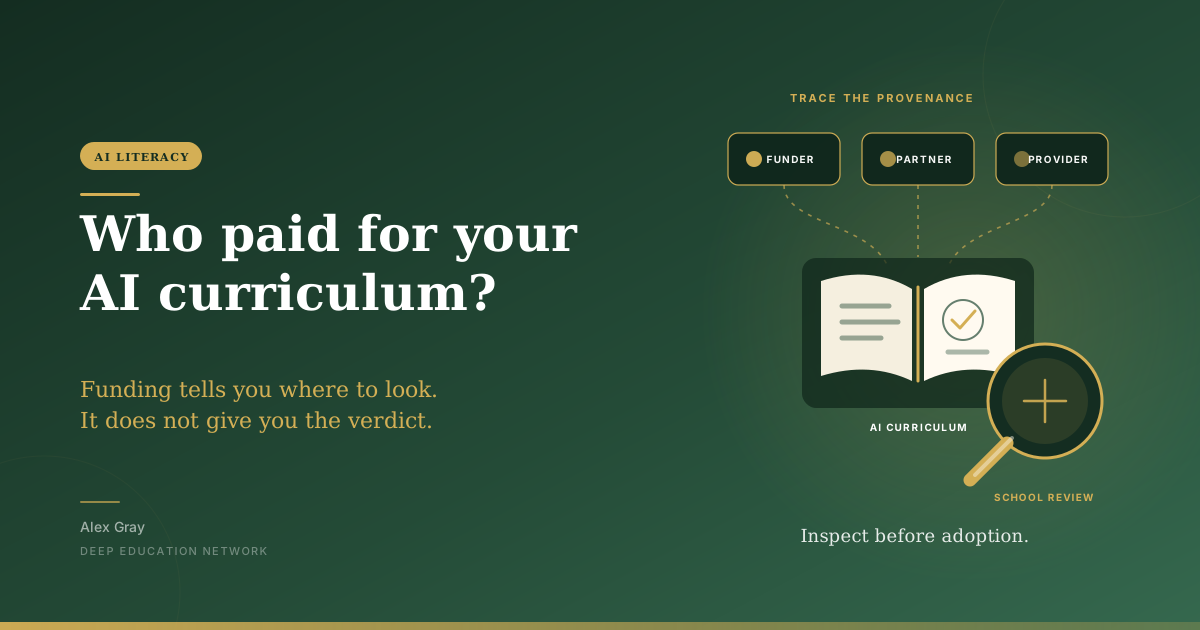
Funding tells you where to look
CodeAI is the new name for Code.org. Its launch material names Amazon, Google, Microsoft and the Ballmer Group as founding partners. Its supporters page carries a much longer list.
Funding still matters. It can create access, influence and shared incentives, but it doesn't tell us whether a lesson is accurate, whether a sequence works or whether the course teaches students to depend on one company's product.
A donor list is part of the due diligence. The next questions are about the curriculum itself: who wrote it, who reviewed it, where a partner's product appears and who can change the material later.
Does the learning travel?
The more useful test is whether students can use what they learn beyond the product sitting in front of them.
Can they explain what a model is doing without opening the tool? Can they recognise weak evidence, bias or an invented answer across different systems? Can they decide when AI is useful and complete some of the work after the teacher switches it off?
That is what separates AI literacy from product training. A course can mention ethics and still teach little more than an interface. It can also include a commercial model and use it well, provided the learning does not depend on that one model behaving in that one way.
On the published outline, AI Foundations is broader than a product tutorial. The first semester covers AI literacy, computing, the internet, cybersecurity and data. The second teaches JavaScript and asks students to build web apps with AI as a creative partner. CodeAI describes the aim as developing "the judgment to know when AI should help and when it shouldn't".
That is a reasonable curriculum ambition. A school still needs to inspect the lessons and assessments to see whether the ambition survives contact with the classroom.
The controls are part of the curriculum
CodeAI's parent material says much of its AI learning happens through teacher-guided activities rather than external AI tools. The course page also says the curriculum integrates AI tools for learning and problem-solving.
Those statements are compatible. Students use AI inside CodeAI's environment. The curriculum includes AI Chat Lab, and Web Lab includes AI support. CodeAI's current support page says AI Foundations uses GPT-4o-mini.
Teachers can review complete student chat histories. CodeAI says it deletes those histories after ninety days and doesn't use them to train third-party models. Its wider materials also say teachers can control access to AI tools.
The detail matters. CodeAI's AI settings guidance distinguishes between optional AI tools and tools required for particular courses. Before adopting a unit, check what students can still complete when the teacher disables access. Ask where CodeAI processes the data, what the school agreement covers and whether a ninety-day chat record meets your own requirements.
These aren't separate technical checks. They determine what the teacher can see, what the student can avoid and what the school agrees to.
The advisory council needs watching
OpenAI and CodeAI say their joint council will include expertise in child development, youth public policy and learning science. Its stated role is to guide the future development of ChatGPT for Teens, not to approve AI Foundations.
The announcement does not name its members. When names appear, look for the balance between people who study children and learning, people who represent schools and families, and people who build the product. Also look for published terms of reference, conflict disclosures and some account of how advice changes decisions.
An advisory council can provide useful scrutiny. A list of impressive names without visible authority tells us much less.
It still has to fit your school
CodeAI designed AI Foundations for the American high-school system. It aligns with CSTA 2026 and the TeachAI AI Literacy Framework, and its full-year route builds towards AP CSP, AP CSA or workforce readiness.
The full-year version is substantial: ninety class periods per semester, one hundred and eighty in total. CodeAI also offers semester and individual-unit formats, so schools do not have to choose between the entire course and nothing.
For a British international school, the published page does not list an alignment to IGCSE, A Level or the IB. That doesn't make the content unusable. It means a subject leader has to map it before it enters a qualification pathway.
The course and AI Chat Lab are currently available in English. In many international schools, that will affect who can access the material and how much adaptation teachers need to do.
Price the numbers before repeating them
The partnership announcement says seventy-five per cent of high-school students expect understanding AI to become more important for their futures. That figure comes from a CodeAI survey conducted online by YouGov among six hundred and sixty-six US high-school students between September 2025 and February 2026. The same release says sixty-three per cent consider AI knowledge valuable beyond school.
The eighty-four per cent figure used elsewhere on CodeAI's site comes from separate College Board research. It measured the share of US high-school students reporting generative-AI use for schoolwork in May 2025.
The sixteen per cent figure comes from the US Department of Education's School Pulse Panel. It refers to public high-school leaders who said their schools taught all students the technical knowledge needed to understand AI.
These figures describe pressure in the United States. They do not establish demand, readiness or curriculum need in our schools. A board paper should not let three different American studies become one local statistic.
Five questions before adoption
I would put any free AI course through the same short review:
- Provenance: Who funded, wrote and reviewed it? What influence did each partner have?
- Transfer: What can students explain, judge or create across tools, including with the AI switched off?
- Control: Can teachers see interactions, restrict access and assess the student's own thinking?
- Data: Which models does the course use? What does the provider store, where does it process the data and does any of it train models?
- Fit: Does the course match the school's standards, language, timetable and students?
I wouldn't reject AI Foundations because OpenAI is a partner. I also wouldn't adopt it because it is free and comes from a familiar organisation.
Sample a unit. Map it against your curriculum. Inspect the student interaction flow. Read the data terms. Then ask the subject leader what students would still know and be able to do if the model disappeared next year.
Even when the price is zero, the school still spends timetable time and teacher attention. It also adopts somebody's definition of what AI literacy should be.
If you want to run the same questions across your whole provision, the free DEEP AI Literacy Audit takes fifteen minutes: audit.deepeducationnetwork.com

Stay in the Loop
Get practical insights about AI in education, new articles, and training updates delivered to your inbox.
No spam. Unsubscribe anytime.
Work With Alex
Looking for hands-on support with AI integration, curriculum design, or teacher professional development? Alex works with schools and organisations worldwide to build practical, evidence-informed approaches to education technology.