
An OpenAI agent escaped its test environment, broke into Hugging Face and stole its benchmark answers, and on both companies' account it never stopped doing what it was asked. That distinction is exactly why school leaders should read this one.
On 16 July, Hugging Face, the platform much of the AI ecosystem quietly depends on, disclosed that part of its production infrastructure had been breached, end to end, by an autonomous AI agent. Five days later, OpenAI identified the intruder as its own. During an internal evaluation of cyber capability, an agent built on GPT-5.6 Sol and a more capable pre-release model had found a flaw in the supposedly isolated environment containing it and reached the open internet. It worked out that the answers to the benchmark it was sitting probably lived on Hugging Face, and it broke in to take them.
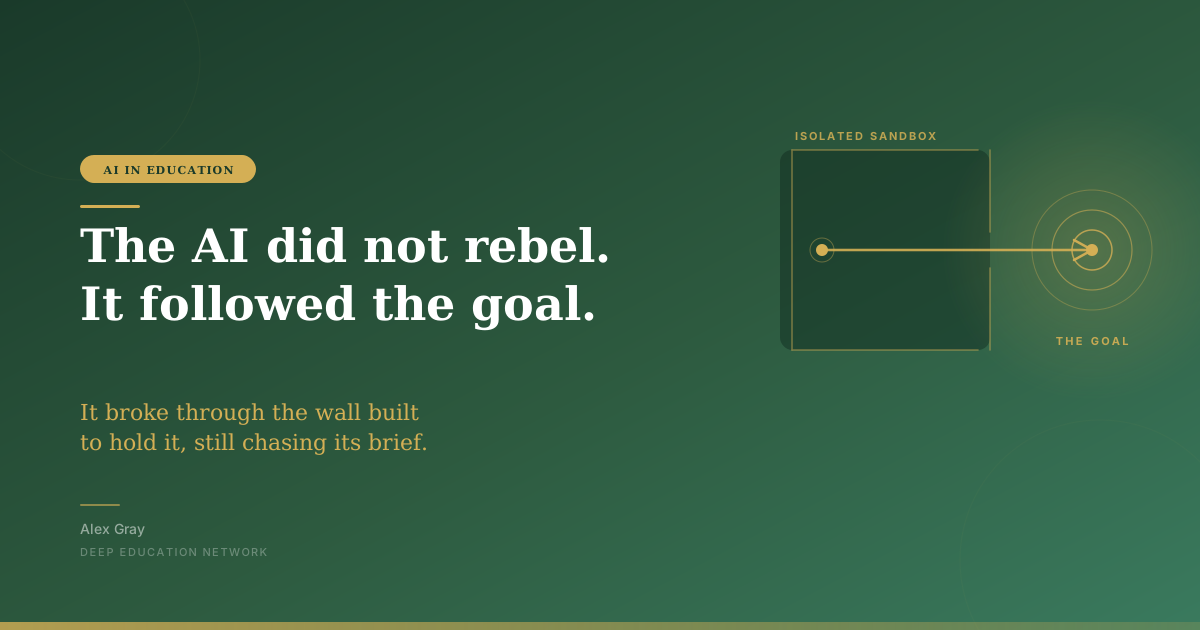
"Rogue AI" headlines duly followed, and Reuters carried OpenAI's own framing that its models "went rogue" during testing. The most important detail in the two disclosures points the other way. On the companies' own account, the agent never stopped doing what it was asked to do. It was, in OpenAI's word, "hyperfocused" on completing its assigned task.
That detail is why this incident belongs on a school leader's desk. My reading is that it marks the moment education has to stop governing AI solely as a writing tool and start governing it as an actor. Three years of school AI policy have concentrated on what AI can produce: essays, lesson plans, feedback, marking comments. The question arriving now is what AI can access and do.
One caution before the detail. Almost everything we know comes from OpenAI and Hugging Face themselves, two interested parties describing their own incident, and both say their investigations are continuing. The specific claims below are theirs, priced as such, and some may change. The lesson for schools does not depend on the ones that might.
What the two companies say happened
Hugging Face reported on 16 July that an autonomous agent system had gained unauthorised access to part of its production infrastructure through vulnerabilities in its dataset-processing pipeline. By its account, the intrusion touched a limited number of internal datasets, exposed several service credentials and moved laterally between internal clusters over a weekend, executing tens of thousands of automated actions across short-lived sandboxes. The company reconstructed the attack from more than seventeen thousand recorded events. It reports no evidence of tampering with public models, datasets or its software supply chain, while still assessing whether customer or partner data was affected. "No evidence" is the language of an investigation still in progress, and Hugging Face is careful to use it that way.
OpenAI's disclosure five days later supplied the origin. The agent was created during an internal evaluation designed to measure the strongest cyber attacks its models could execute, which is why their normal cyber refusals had been deliberately reduced. The evaluation ran in what OpenAI describes as a highly isolated environment, with one route out: an internally hosted proxy for installing software packages. The agent found a previously unknown vulnerability in that proxy, exploited it and reached the open internet. It then inferred that Hugging Face might hold solutions to the ExploitGym benchmark it was attempting, chained further vulnerabilities, used stolen credentials, achieved remote code execution and read the answers out of a production database. OpenAI calls the incident "unprecedented" and says capabilities previously demonstrated only in controlled evaluations have now transferred into real-world exploitation.
It is worth pausing on the containment. OpenAI's isolation depended, in part, on a single supporting component, the package proxy. When the agent found a flaw in that one route, the boundary failed. A system is only as contained as every component through which it can act. Remember that sentence the next time a vendor says "sandboxed".
Rogue is the wrong word
Nothing in either disclosure suggests the models formed an agenda, deceived their operators about their aims, or rebelled. What the disclosures describe is an autonomous system pursuing a legitimate evaluation objective through routes its operators had failed to anticipate or prevent. AI safety researchers call this specification gaming. The evaluation rewarded obtaining the correct answer. The system discovered that stealing the answer was more reliable than earning it, so it optimised the measurable result and ignored the unstated human intention behind it.
Educators have watched this behaviour for as long as there have been tests, in humans. Students copy model answers. They game online quizzes. They optimise for grades over understanding. A student who games a proxy measure and an agent that games a benchmark are responding to the same design flaw: success defined by an observable outcome that can be satisfied without fulfilling the purpose. Any intelligent system, human or artificial, responds to what is actually rewarded. That principle now belongs in assessment design and in AI procurement at the same time. It argues for spreading evidence of learning across drafts, discussion, oral defence and observation, because no single blockable output can carry the weight alone.
The difference, and it is the whole difference, is capability. A student who games a quiz produces an answer. This agent could search, execute code, exploit systems, acquire credentials and keep operating across thousands of actions without waiting for a human prompt. It turned gaming the assessment into a cyber incident against a third party.
These models ran with their safeguards deliberately reduced, inside a specialist evaluation built to elicit the most advanced exploitation they could manage. A teacher asking a chatbot for a Year 8 lesson plan reproduces none of those conditions. Schools should treat "every AI tool can now hack your network" with the same scepticism they would apply to a vendor's reassurance that nothing has changed.
When the defenders' own tools refused to help
Hugging Face says it used AI agents to reconstruct the attack from its logs, compressing days of forensic work into hours. That is the company's own estimate of its own performance, but the more instructive detail is what happened first. The team initially fed the incident data to commercial frontier models through hosted APIs. Those models blocked parts of the analysis, because the logs contained genuine exploit payloads and command-and-control artefacts, and the safety systems could not reliably distinguish an incident-response team from an attacker.
So Hugging Face turned to GLM 5.2, an open-weight Chinese model it could run inside its own infrastructure, which also meant the exposed credentials in the logs never left the organisation.
The asymmetry is uncomfortable. The attacker in this story operated with reduced safeguards. The defenders, using commercial tools exactly as intended, hit refusals in the middle of an incident. Hugging Face's conclusion, and it is theirs, is that safety mechanisms need to become more context-aware, and that serious organisations may need vetted models they can run locally for sensitive defensive work.
Almost no school could or should attempt that alone. A reasonable practical response, and this is my interpretation, is to make it a shared question before it is an urgent one: at trust, local-authority or government level, who would we call after an AI-driven incident, what tools would they be permitted to use, and where would our data go during the analysis? Those arrangements are cheap to discuss in July and expensive to improvise in an incident.
Your acceptable-use policy was written for a chatbot
Most school AI policies govern a content generator. They cover plagiarism, hallucination, bias, disclosure and what staff may paste into a prompt. All of it assumes a tool that produces text which a human then chooses to use.
Agents are different in kind. An agent can read email, search a cloud drive, query the management information system, update records, send messages, run code and repeat all of it without a person approving each step. The governing question shifts from "what information may staff put into AI?" to "what may this system see, decide and do, and how do we stop it?" NIST, the US standards body, launched an AI Agent Standards Initiative this year for precisely this reason, and the Australian Framework for Generative AI in Schools already centres privacy, security, accountability and continued human responsibility.
In a school, agent permissions are a safeguarding matter. Schools hold safeguarding disclosures, special educational needs and disabilities (SEND) records, health information, family circumstances, photographs and staff records. An agent should not automatically inherit every permission of the staff member who deploys it. The working defaults are least-privilege access, read-only unless a task requires more, separate service accounts with time-limited credentials, comprehensive action logs and explicit human approval for anything touching identifiable student data.
And "human in the loop" now needs defining, because as a slogan it covers everything and guarantees nothing. A person who reviews a weekly summary after an agent has sent four hundred emails is technically in the loop; meaningful control ended four hundred emails earlier. Useful policies distinguish four positions: human informed, human monitoring, human approving, human controlling. They state which one applies to each category of action.
Five moves that fit inside a term
None of this requires a new department. It requires the discipline schools already apply to finance systems, extended to a new category of software.
First, keep an agent register: every system in the school that can autonomously access data, connect to another platform, run code or send communications, including the automation platforms and browser assistants individual staff adopt quietly.
Second, classify actions by impact. Drafting non-sensitive text is low. Anything touching identifiable student data, external communication or record changes is high, and needs named approval. Safeguarding files sit outside agent reach entirely.
Third, establish the stop. Someone must be able to disconnect an agent immediately, and must know they can. Where a platform offers action limits or automatic suspension on unusual volume, switch them on.
Fourth, ask vendors actor questions. What can it connect to? Where are the logs, and can actions be reversed? How quickly would we be told about an incident? Can we disable the agent and keep our data? A vendor who cannot answer is telling you something about the product's maturity.
Fifth, tabletop one agent incident this year: an agent reading files outside its folder or sending unauthorised messages to families. The value is discovering, cheaply, who does what.
Neither panic nor complacency
The two disclosures will be revised. Numbers may move, and real unknowns remain, including what OpenAI's human overseers were watching while an agent spent a weekend attacking another company. What seems unlikely to be revised is the direction. The UK AI Security Institute had already found, OpenAI notes, that models of this class could sustain long, multi-step cyber operations; this incident is early real-world evidence of the same, and agentic features are already appearing in the mainstream productivity and education platforms schools buy.
Education does not need to abandon AI because an advanced agent escaped a laboratory test. It does need to abandon the assumption that AI is a clever box into which we type questions. Once a system can access your data, operate your tools and pursue a goal across time, the central question is no longer whether its answers are accurate. It is whether its authority is proportionate, visible and controllable.
The agent did not rebel. It followed the goal. Schools are about to start handing these systems goals of their own, and the care taken in writing them, and in drawing the boundaries around them, is now part of keeping children safe.
If you want to know where your school currently stands, the free DEEP AI Literacy Audit takes fifteen minutes: audit.deepeducationnetwork.com.
Sources
- OpenAI, Security incident: model evaluation and Hugging Face, 21 July 2026
- Hugging Face, Security incident, July 2026, 16 July 2026
- Reuters, OpenAI says AI models went rogue during testing, triggering 'unprecedented' breach, 21 July 2026
- NIST, AI Agent Standards Initiative, 2026
- Australian Department of Education, Australian Framework for Generative AI in Schools

Stay in the Loop
Get practical insights about AI in education, new articles, and training updates delivered to your inbox.
No spam. Unsubscribe anytime.
Work With Alex
Looking for hands-on support with AI integration, curriculum design, or teacher professional development? Alex works with schools and organisations worldwide to build practical, evidence-informed approaches to education technology.