
73% of UK secondary students say AI cannot replace their teacher's empathy, and three-quarters want AI in their lessons. The new OUP report shows AI is not replacing teaching. It is redistributing it. Here is what moves, what does not, and what it asks of school leaders.
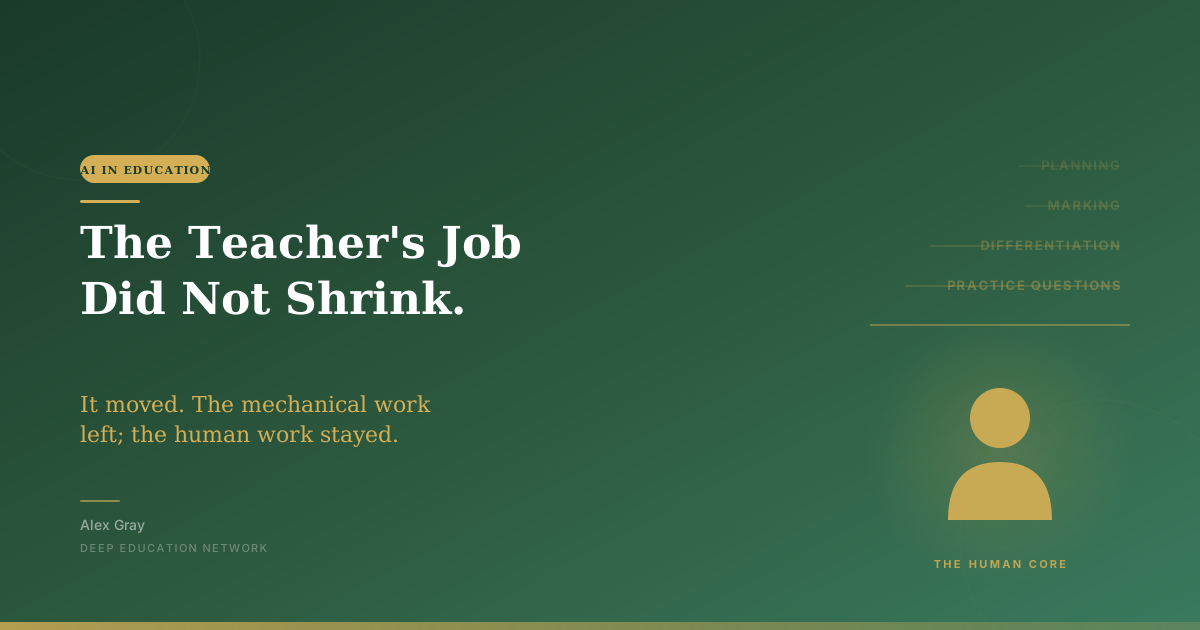
The teacher's job did not shrink. It moved.
A finding from the Oxford University Press Navigating AI in Education report, published this month, is being underdiscussed.
Of nearly four thousand UK secondary students surveyed, seventy-three per cent said AI will not be able to replace their teacher's empathy, personality, or ability to notice when someone is struggling. Three-quarters said they wanted their teachers to use AI in lessons, particularly to make difficult material easier to understand and to speed up planning and feedback.
The students surveyed are clear. They want AI in the classroom. They also know it does not replace the person at the front of the room. The two are not in tension. They are part of the same picture, and it is a picture most current conversations about AI in education are not drawing accurately.
The panic narrative treats AI as a substitute for the teacher. The students surveyed in the OUP study treat AI as a redistribution of the teacher's work. The students are correct.
What is actually being automated
The most useful way to think about what AI is doing to teaching is not to ask which jobs disappear, but which parts of the job move.
The mechanical work moves first. Lesson planning, differentiation, first-pass feedback on extended writing, generation of practice questions, summary and revision material, basic explanation of standard content. These are now better and faster with AI in the loop than without it. Teachers who treat AI as a planning collaborator and a marking assistant report time savings of several hours a week. Khan Academy, the OECD, and a growing number of UK and US school networks have published broadly consistent findings.
The judgement work does not move. Knowing whether a student understood the lesson or learnt to look as if they did. Noticing the change in posture when a topic touches something personal. Deciding when a struggling student needs more challenge and when they need less. Reading the silence in the back row. Choosing the right next question to ask a particular child, in a particular moment, on a particular morning. None of this is going to be automated, and treating it as if it might be is the conceptual mistake at the centre of most current AI-in-education discourse.
The relational work does not move either. Building the trust that lets a teenager admit they do not understand something. Modelling for a class what it looks like to be a thoughtful adult who reads, doubts, and revises their views. Holding the line on standards while showing genuine warmth. Knowing the family context. Caring whether a student is sleeping. These are not soft skills appended to the real job. They are the job.
The shape of the new teaching
If the mechanical work is being absorbed and the judgement and relational work is not, then the teaching role is being concentrated, not eliminated.
Adam Grant has written, in his book Think Again and in his more recent commentary, that the hallmark of expertise is no longer how much you know but how well you synthesise. The argument applies to teachers as much as to students. The teaching role of the next decade is less about delivery of content, which AI can now do at reasonable quality and at scale, and more about the synthesis work that has always sat underneath good teaching but has been buried under the mechanical load.
That synthesis work, when listed in plain language, is the work students name in the OUP data when they say AI cannot replace their teacher's empathy. It is the work of:
- reading a class and adapting in the moment
- connecting the curriculum to a specific student's interests and history
- deciding which AI output is worth a class's attention and which is misleading
- modelling the values a young person is forming, often unconsciously
- asking the question no algorithm would think to ask
- protecting the time and space for slower thinking when everything in the environment is accelerating
The new teaching role is harder than the old one in some respects. It also asks more of teachers as people, because more of the unique value comes from who the teacher is rather than what the teacher delivers. That is a real cost. It is also a real upgrade in professional status, properly understood.
What this asks of school leaders
If this analysis is broadly right, school leadership has two obligations that follow from it.
The first is to free teachers from the mechanical work AI now does well. Lesson planning, differentiation, first-pass feedback, generation of practice questions, common queries. These should be off the average teacher's plate within a year, not because AI is replacing teachers but because keeping these tasks in-house is now poor use of expensive professional time. Schools that do this carefully will have teachers with more capacity for the judgement and relational work. Schools that do not will continue to grind their teachers into burnout while students use AI to outpace the system anyway.
The second is to protect, and indeed expand, the time and structures for the work that AI does not touch. Time for reading and reflection. Time for one-to-one conversations with students who need them. Time for collegial moderation, where teachers think together about the work in front of them. Time for the kind of formative feedback that requires sitting next to a student and noticing. These investments have always been associated with the most effective schools. They are about to become decisive.
The OUP report contains a more uncomfortable finding worth pairing with the seventy-three per cent figure. Only fifteen per cent of the students surveyed said their school had given them enough guidance on AI. The students who say their teachers are irreplaceable are also saying that those teachers are not currently equipped to teach them what they most need. That gap is closable, but only if leaders invest in the professional development the OUP report explicitly calls for.
The argument in one sentence
The teaching role is being redistributed, not replaced. The mechanical parts are being absorbed by AI. The judgement, relational, and synthesis parts are being concentrated into the teacher. The job, in other words, is becoming harder and more important at the same time.
The schools that understand this will design the next decade around it. The schools that do not will spend the next decade writing AI policies while their teachers leave the profession.
From the podcast
This piece is the companion to last weekend's episode of The International Classroom with Ryan Trattner, co-founder and CTO of StudyFetch. The conversation focused on what AI tutoring should look like when it is built to scaffold thinking rather than to replace it. The line in the episode that pushed this piece into shape was Ryan's observation that the moment a tool becomes frictionless is the moment it stops being a teacher.
Also available on Spotify and Apple Podcasts.
Alex Gray is the founder of DEEP Education Network and host of The International Classroom podcast. He is Head of Digital Learning and AI at Arcadia British School Dubai.
If you want to know where your school sits on AI and digital literacy, the free DEEP AI Literacy Audit takes fifteen minutes: audit.deepeducationnetwork.com.
Frequently asked
Will AI replace teachers?
No. The 2026 OUP survey of nearly 4,000 UK secondary students found that 73 per cent say AI cannot replace their teacher's empathy, personality, or ability to notice when a student is struggling. AI is absorbing the mechanical parts of teaching, such as planning, differentiation and first-pass feedback, while the judgement and relational work is being concentrated into the teacher rather than removed.
Which parts of teaching can AI actually do?
The mechanical work: lesson planning, differentiation, first-pass feedback on extended writing, generation of practice questions, and basic explanation of standard content. What it cannot do is the judgement work (reading whether a student has genuinely understood) or the relational work (building the trust that lets a student admit they are lost).
What should school leaders do about AI and teacher workload?
Two things. Free teachers from the mechanical work AI now does well, so it is off the average teacher's plate within a year. And protect, then expand, the time for the work AI does not touch: one-to-one conversations, formative feedback, reading and reflection, and collegial moderation. The same OUP report found only 15 per cent of students feel their school has given them enough guidance on AI, so investment in professional development is the missing piece.
Sources
Oxford University Press, Navigating AI in Education: Pupils' perspectives on the role of AI in the classroom, June 2026.
HEPI (Higher Education Policy Institute), Student Generative AI Survey 2026 (Report 199), authors Rose Stephenson and Charlotte Armstrong, published 12 March 2026.
Parker, L., Loper, A. J., Carter, C. W., Hayes, J., and Karakas, A., Longitudinal insights into AI in education: Usage, ethics, and policy development in higher education, Computers and Education Open, Vol. 10, 2026, 100329.
Adam Grant, Think Again: The Power of Knowing What You Don't Know, Viking, 2021.
Adam Grant, Granted newsletter and public commentary, 2025.
Filed under

Stay in the Loop
Get practical insights about AI in education, new articles, and training updates delivered to your inbox.
No spam. Unsubscribe anytime.
Work With Alex
Looking for hands-on support with AI integration, curriculum design, or teacher professional development? Alex works with schools and organisations worldwide to build practical, evidence-informed approaches to education technology.