
Ninety-five per cent of UK undergraduates now use AI. The debate over whether they should has been settled, by them. The harder question for schools: are students rethinking with AI, or escaping the work of thinking through it?
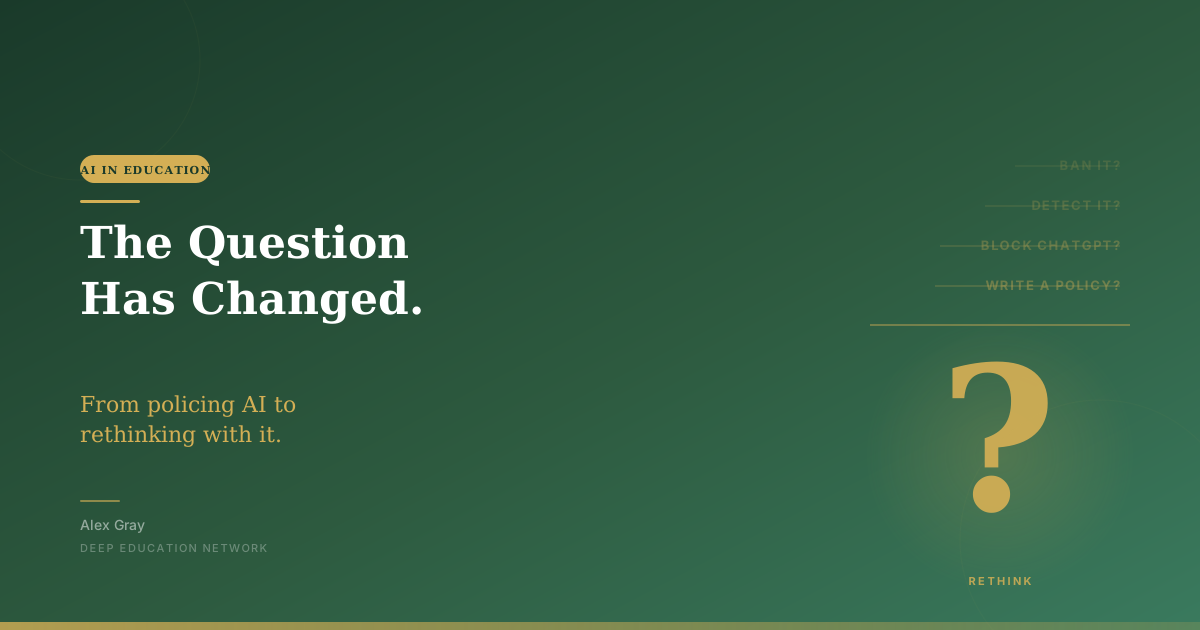
The question has changed: from policing AI to rethinking with it
The debate in most schools is still the wrong one.
Should students be allowed to use AI? Which tools should we block? What does our AI policy say about ChatGPT in coursework? These are the questions that fill staff meetings and dominate the inboxes of senior leaders. They are also questions that have already been answered, just not by the people asking them.
Students are using AI. They have been for two years. The settled finding from every credible survey in the field is that AI use among secondary and university students is now the norm, not the exception. The HEPI Student Generative AI Survey 2026, the third iteration of the annual study from the Higher Education Policy Institute, found that ninety-five per cent of UK undergraduates now use AI in at least one way and ninety-four per cent use it for assessed work. The proportion directly including AI-generated text in assessments has risen to twelve per cent, up from eight per cent in 2025 and three per cent in 2024.
A separate longitudinal study, published this year in Computers and Education Open, tracks the trajectory rather than the snapshot. Parker and colleagues surveyed more than 300 students across four semesters in a US teacher education programme. Use of AI for assessment preparation rose from fifty-seven per cent to eighty-three per cent over that period. Use for studying rose from forty-four per cent to seventy-six per cent. The trend is not stabilising. It is accelerating, in the population most likely to enter classrooms within the next five years.
The argument we are still having is one the students finished having a long time ago.
The more useful question is harder, and it is the one this article is about.
What policy cannot do
A policy can tell a student what is permitted. It cannot tell them what is wise. A policy can flag the use of a tool. It cannot shape the kind of thinker the tool produces.
The evidence here is now substantial.
A study from the MIT Media Lab, published in 2025 and titled Your Brain on ChatGPT, asked fifty-four participants to write essays under three conditions. One group used an LLM. One used a search engine. One used nothing but their own brain. The study tracked them across four sessions and measured cognitive activity using EEG.
The headline finding has been widely quoted. Eighty-three per cent of participants in the LLM group could not accurately quote a single sentence from the essay they had just written, minutes after writing it. The quieter finding deserves more attention. EEG showed the weakest neural connectivity in the LLM group, and the effect persisted even after the tool was taken away in a later session. The researchers describe this as cognitive debt.
A separate finding, from RAND's American Youth Panel in December 2025, is notable for a different reason. Sixty-seven per cent of US students themselves now report that heavy AI use harms their critical thinking. That figure was up more than ten percentage points in ten months.
HEPI's 2026 findings tell a similar story from the UK undergraduate population. The data is now polarised. Forty-nine per cent of students say AI has improved their experience. A significant minority report the opposite. One respondent quoted in the report describes using AI to summarise dense readings and focus on critical analysis. Another, in the same survey, says simply: I'm not using my brain at all.
Parker's longitudinal data adds a further finding worth attention. The study identifies a statistically significant difference in ethical perceptions between AI users and non-users in the same cohort. The two groups are not just behaving differently. They are reasoning differently about the same question. That is a more interesting result than the headline usage numbers, because it suggests that using these tools shapes the moral framework students bring to them, rather than the other way around.
None of these findings tell us that AI is bad for learning. They tell us that AI used without thought is bad for learning. That is a different argument, and it is the one schools need to start having.
The Grant frame
The most useful lens on this comes from Adam Grant, the organisational psychologist, who has spent a decade arguing that the central skill of a modern intellectual life is the willingness to rethink.
In Think Again, Grant distinguishes between four mental modes. The preacher defends a settled belief. The prosecutor attacks the beliefs of others. The politician performs the beliefs the audience wants to hear. The scientist tests, doubts, and revises.
His point is that most of us spend most of our time in the first three modes and almost none of our time in the fourth. The scientist mindset is the one that allows a person to change their mind in response to evidence. It is also the one most exposed by an AI-saturated environment, because the easiest thing to do with an AI is ask it to confirm what you already think.
Grant has been making a related argument more recently. The hallmark of expertise, he writes, is no longer how much you know. It is how well you synthesise.
If that is correct, much of what schools currently assess is measuring the wrong thing. Most assessment still grades recall and structured response. It measures what students know. The skill the labour market and the wider intellectual environment is now demanding is the ability to take three sources, two arguments, and one half-formed instinct and make something coherent. Synthesis, on this account, is the new literacy. Most current assessments do not test it.
The question that replaces the old one
The question schools have been asking is: should students use AI?
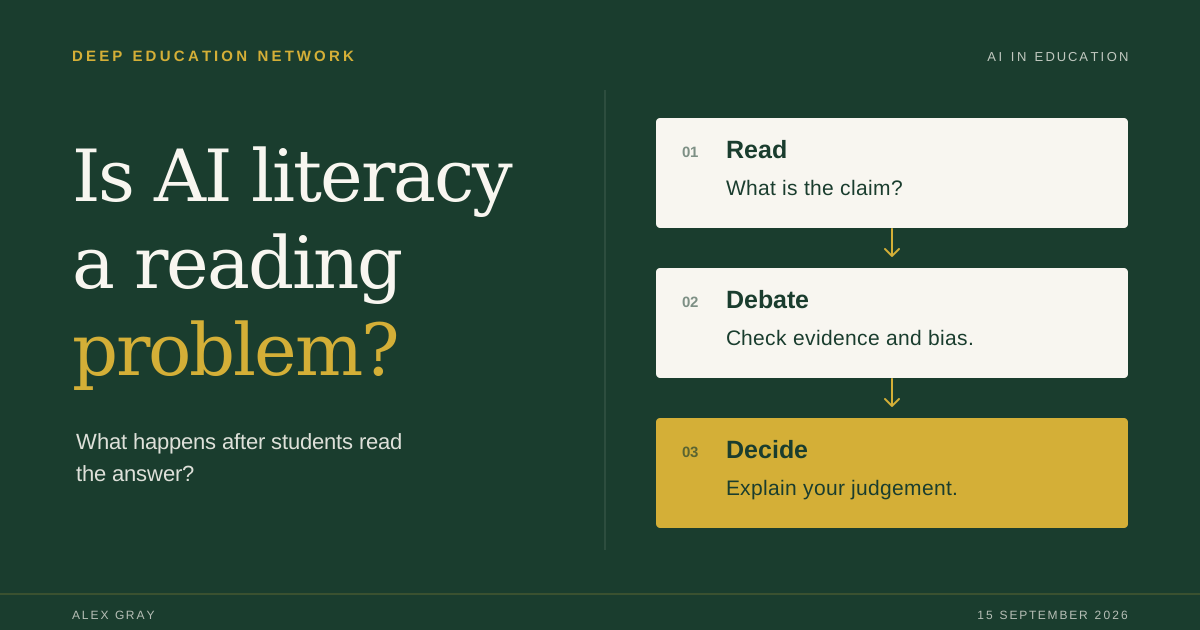
The question that replaces it is: are students rethinking with AI, or escaping the work of thinking through it?
This is a question that policy cannot answer at an institutional level. It has to be answered student by student, lesson by lesson, assignment by assignment. It is closer to the kind of question a good teacher already asks about a student's writing. Did they actually understand this, or did they learn to look as if they did?
The shift this question demands is not a shift in policy. It is a shift in pedagogy.
It means designing assessments where the use of AI is assumed and the test is whether the student can do something with what the AI produces. It means asking students to show their prompts and their revisions, not hide them. It means treating prompt design, source evaluation, and synthesis as core skills rather than optional add-ons. It means rewarding the moments where a student notices something the AI got wrong and pushes back, because those moments tend to signal genuine understanding.
It also means accepting that some of what we have always taught is no longer the central point. Recall is no longer the central point. The structured five-paragraph response is no longer the central point. The forty-mark exam question that tests whether a student can produce coherent prose under timed conditions is no longer the central point. Those skills used to be proxies for thinking. They are now less reliable as proxies than they were.
Where this leaves leaders
For school leaders, the most practical action this term is not to write a new AI policy. The policy will be out of date in six weeks. The more useful exercise is to ask, across every department, a single question.
What is this subject teaching students to do that an AI cannot already do better?
If the honest answer is "not very much," the curriculum needs work. If the honest answer is "we teach them to think, to question, to synthesise, to argue, to notice," then the curriculum is broadly intact and the assessment needs work, because in most cases the assessment will not be measuring those things.
The data on AI use in schools and universities has now stabilised enough to permit a clearer view. The students have adopted these tools at a speed institutions have not matched. The students themselves report ambivalence about the effect on their thinking. The research is beginning to quantify the cognitive cost of use without scaffolding. The shape of the next phase of the conversation is clear enough to act on.
It does not begin with policy. It begins with a different question.
From the podcast
This article is the companion piece to the latest episode of The International Classroom, with Ryan Trattner, co-founder and CTO of StudyFetch. The discussion focuses on how AI tutoring should be designed to scaffold thinking rather than replace it, where the line between assistance and outsourcing sits in practice, and what AI in the classroom looks like when it is built for learning rather than for speed.
Also available on Spotify and Apple Podcasts.
If you want to know where your school sits on AI and digital literacy, the free DEEP AI Literacy Audit takes fifteen minutes: audit.deepeducationnetwork.com.
Frequently asked
Should schools ban AI in coursework?
A blanket ban is no longer enforceable. The HEPI 2026 survey found that 94 per cent of UK undergraduates use AI for assessed work and 12 per cent submit AI-generated text directly. The more productive question is whether AI is being used to scaffold thinking or to bypass it, and that is a question of assessment design, not policy.
Are students using AI to cheat?
Some are. Most are using it to summarise, plan, revise, and translate. The 2026 data shows widespread, varied use rather than wholesale fraud. The more interesting finding is that 67 per cent of US students themselves report that heavy AI use harms their critical thinking, which suggests the cost is often borne by the student more than by the institution.
What should an AI policy actually do?
A policy can flag what is permitted. It cannot teach a student to think. The most useful institutional move is not a new document but a curriculum question: what is this subject teaching students to do that an AI cannot already do better? If the answer is "not very much," the assessment, not the policy, needs work.
Sources
HEPI (Higher Education Policy Institute), Student Generative AI Survey 2026 (Report 199), authors Rose Stephenson and Charlotte Armstrong, published 12 March 2026.
Parker, L., Loper, A. J., Carter, C. W., Hayes, J., and Karakas, A., Longitudinal insights into AI in education: Usage, ethics, and policy development in higher education, Computers and Education Open, Vol. 10, 2026, 100329.
MIT Media Lab, Your Brain on ChatGPT: Accumulation of Cognitive Debt when Using an AI Assistant for Essay Writing Task, 2025.
RAND Corporation, More Students Use AI for Homework, and More Believe It Harms Critical Thinking, American Youth Panel, December 2025.
Adam Grant, Think Again: The Power of Knowing What You Don't Know, Viking, 2021.
Adam Grant, Granted newsletter and public commentary, 2025.
Filed under

Stay in the Loop
Get practical insights about AI in education, new articles, and training updates delivered to your inbox.
No spam. Unsubscribe anytime.
Work With Alex
Looking for hands-on support with AI integration, curriculum design, or teacher professional development? Alex works with schools and organisations worldwide to build practical, evidence-informed approaches to education technology.