
An expert report suggests AI has promise during practice. A proposed lesson routine puts independent work before and after it.
My classes have four lessons a week. I'm planning to protect one of them for practice and feedback, with AI support available after students have shown what they can do independently.
When should students use AI? For this plan, I need to know what they've understood before they open it, what work they'll do with it, and what they'll still be able to do when it's closed.
That sequence is my proposed response to an October expert consensus report from the University of Minnesota. It hasn't tested a one-in-four timetable. The report gives us a reason to look closely at practice and feedback, and some reasons to be careful about how we organise it.
What the experts agreed on
The project brought together thirty learning scientists and educational researchers. They identified sixty-five learning processes and rated how likely general-purpose generative AI was to enhance or disrupt each one. Forty-two processes reached the report's threshold for consensus on enhancement, vulnerability or both.
The distinction matters. These are expert judgements, informed by research, about tools such as ChatGPT, Claude and Gemini. They aren't results from a classroom trial of this routine, or a verdict on every specialist education product.
The authors describe a pattern across acquiring, practising and applying knowledge. They see promise in using AI to help students consolidate something they've already learned, through feedback, self-testing, examples, questioning and practice. They see vulnerabilities when students hand over the work of acquiring knowledge or using it to think through something new.
It's tempting to turn that into a rule that AI helps in the middle and harms at either end. The report itself says effects depend heavily on how it's used. Motivation, for example, reached consensus for both enhancement and vulnerability. Personalised support might help a student engage; replacing their effort might undermine it.
There are twenty-three processes without consensus. That records disagreement among the experts. It doesn't establish that AI has no effect, or that those uses are safe. The authors also describe serious weaknesses in the empirical evidence. We need to keep that uncertainty visible when we turn their recommendations into teaching plans.
Retrieval still has to happen in the student's head
One awkward detail deserves attention. The experts rated retrieval as vulnerable, while also seeing enhancement potential in self-testing.
A student answering a question from memory is doing the retrieval. If AI supplies the answer before they've tried, they've avoided it. If it asks a question and waits, there's still an opportunity to recall something. The work the student actually does determines whether the activity serves its purpose.
So I'd begin the practice lesson with an unaided attempt. I need to see their explanation, calculation or answer before any generated feedback appears. If the essential knowledge is missing, I can teach it again. A fluent conversation with a chatbot wouldn't give me the same starting information.
Calling something a practice lesson doesn't guarantee that everyone is ready to practise.
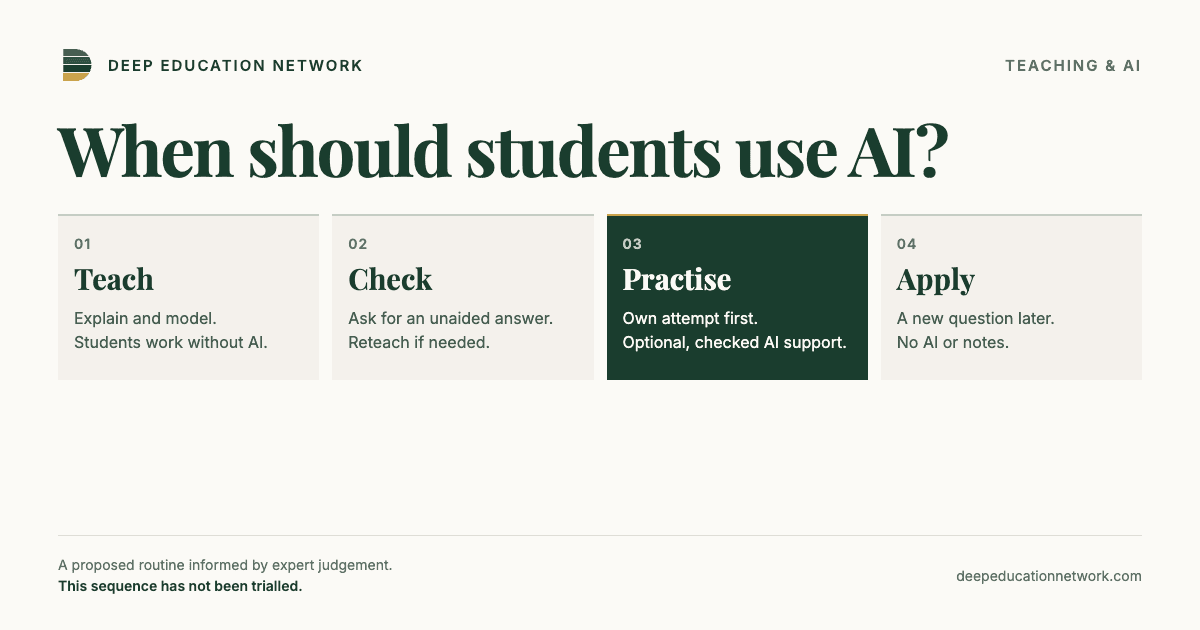
When should students use AI in this routine?
I'm planning four phases. They can run across several lessons; they don't have to fit neatly into four timetable slots.
First, teach and model the new idea. Students explain it in their own words without AI. Teacher preparation can include AI, provided the materials are checked.
Then build and check knowledge. Ask students to connect ideas and answer from memory. This is where I decide whether they have enough understanding to use feedback productively, or need further teaching.
AI support is optional in the practice phase. Students make their own attempt first. A checked question, hint or piece of feedback can help them continue, but they need reliable taught material against which to check it. They should be able to explain what they're changing and why. Copying the suggested answer wouldn't show me that.
Later, change the question or context and ask them to work without AI or notes. That check tells me what needs further teaching. A successful answer while support is present can't settle that on its own.
For this proposed routine, student AI use stays in the practice phase. It can be presented by the teacher through school-approved tools, following the school's age and access rules. Students don't need their own chatbot accounts to take part.
A Year 8 example
I'm reviewing our Year 8 Digestion and Nutrition unit. The guide uses an illustrative example from it, distinguishing digestion from absorption. This example hasn't been trialled.
After teaching the two processes, I could ask: "A student says digestion is food moving into the blood. What have they mixed up?"
If their answer still confuses the processes, I'd return to the taught diagram and model the distinction again. Then I'd ask a fresh unaided question. Offering more generated explanations immediately would make it harder to see whether they'd understood the teaching.
Once they can explain the distinction, a practice task could include a teacher-checked hint: "Separate breaking molecules down from moving them across a wall." That hint could be written by the teacher or prepared with AI. Students would explain how it changes their answer.
The later check uses a different question, without the hint, AI or notes. The guide includes the question and the expected answer, so the teacher has something specific to look for. The planned response to a gap is further teaching.
This is the detail I want in a scheme of work: the question, the answer we're looking for, and what we'll do if it isn't there.
Age and policy still need judgement
The report raises greater concerns about disruption for children in elementary education than for students in secondary or higher education. That broad comparison doesn't establish a separate rule for Year 7 and Year 13.
I'd still expect us to consider students' independence, subject knowledge and ability to check feedback when deciding what support to allow. Those are professional judgements to make in context. A school can have one policy that gives different guidance for different ages, subjects and tasks.
For a middle leader reviewing a unit, a useful starting point is to mark where students first encounter an idea, where they practise it and where they apply it independently. Then look at each proposed AI activity and check what thinking remains with the student. We can do that with an existing scheme of work.
Plan the lesson
The two-page teacher guide develops the routine discussed in Dispatch 022. Page one sets out the phases and readiness checks. Page two includes the Year 8 example and six planning boxes you can complete digitally or print.
Download the teacher guide from the DEN and use it to plan one practice lesson in a unit you already teach. The boxes include what you'll do if students aren't ready and what you'll ask them to do independently afterwards.
Source
Kendeou, P., Greene, J. A., Nixon, N. and colleagues (October 2026). Ways generative AI can support and threaten learning in K-20 US education (Expert Consensus Report). College of Education and Human Development, University of Minnesota. Full report, findings and methods.

Stay in the Loop
Get practical insights about AI in education, new articles, and training updates delivered to your inbox.
No spam. Unsubscribe anytime.
Work With Alex
Looking for hands-on support with AI integration, curriculum design, or teacher professional development? Alex works with schools and organisations worldwide to build practical, evidence-informed approaches to education technology.