
Concrete, honest conversations about AI in education. Al Kingsley on assessment and equity, Tom Raithby on building Chalkd with no coding background, and Matthew Wemyss on what school leaders are missing about student AI use.
There is a version of the AI in education conversation that stays safely abstract. Policies, frameworks, ethical considerations, pilot programmes. All important. None of it particularly useful on a Tuesday morning when you are a teacher with 32 students, a marking pile, and a leadership team that is not sure what to do next.
The conversations I am having on the channel this week are the other kind. Concrete, honest, and in at least one case genuinely surprising.
Here is what dropped this week on The International Classroom and Show Us Your Stack.
Why are we still testing students on knowledge retention?
Al Kingsley joined me for a conversation that starts with a provocation most educators quietly agree with but rarely say out loud: in a world where every fact is instantly available, what exactly is the point of testing students on whether they can recall information?
It is a question that opens into something bigger. If AI changes the value of knowledge retrieval, it necessarily changes the value of how we assess learning. And if assessment changes, the entire architecture of how we design curriculum, structure lessons, and report progress has to follow.
What makes Al's perspective particularly sharp is that he does not stop at the classroom. He pushes into digital equity: who benefits when AI accelerates access to knowledge, and who gets left further behind when the infrastructure, training, or institutional will simply is not there. Education reform and digital equity are not separate conversations. They are the same one.
If you are a school leader who has been treating AI strategy as an IT procurement decision, this is the episode that reframes it as a leadership and values question.
Watch: AI as a Catalyst for Education Reform and Digital Equity | Al Kingsley
A PE teacher with no coding background built an AI tool. Here is what happened.
This is the episode I would send to every educator who has ever said "I am not a developer" and used it as a reason to stop.
Tom Raithby is a PE teacher. He had no formal coding background, no software engineering experience, and no particular reason to believe he could build anything. What he did have was a problem: the marking crisis that is grinding teachers down across the UK and internationally. And enough frustration to do something about it.
So he built Chalkd.
Darren Coxon and I sat down with Tom on Show Us Your Stack to go through the whole thing: the problem he was solving, the stack he used, and the mindset shift that made building without a traditional technical background feel not just possible, but obvious. What comes through clearly is that the barrier to building with AI in education is not technical knowledge. It is the willingness to start.
Watch: How a PE Teacher Built an AI Tool to Solve the Marking Crisis | Tom Raithby
Are school leaders avoiding the most important conversation about student AI use?
Matthew Wemyss is someone who sits close enough to both the leadership and student experience of AI to have an uncomfortable answer to that question: yes, often.
In this episode of The International Classroom, we get into what AIDUCATION actually looks like from the inside. Not the conference programme, but the student experience of building chatbots, engaging with AI tools as learners rather than passive recipients, and what genuine EdTech community looks like when it is done well.
The provocation Matthew leaves you with is a useful one as schools head into end-of-year review season. You have probably updated your AI policy. You may have run some CPD. But do you actually know what your students are doing with AI right now, and are you having the conversations that would tell you?
What connects all three
Al is asking structural questions that most school systems are avoiding. Tom built his own answer to a problem nobody else was solving fast enough. Matthew is arguing that students need to be inside the conversation, not just subject to its outcomes.
The thread running through all three is agency: the willingness to act without waiting for perfect conditions, complete certainty, or someone else's permission. That is the posture DEEP Education Network exists to support. Not AI adoption as compliance, but AI navigation as a form of leadership.
Where to go next
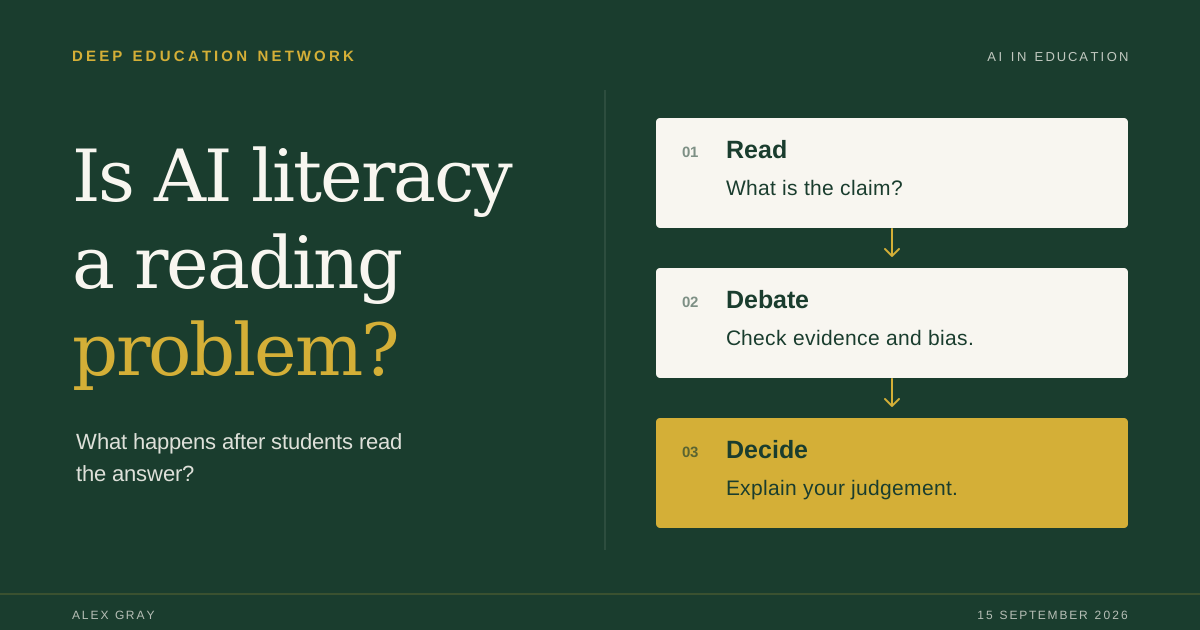
If you are not sure where your school actually stands on AI literacy, not where leadership thinks it stands, but where the evidence suggests it does, the DEEP AI Literacy Audit is the place to start. It is free, takes around 15 minutes, and gives you a clear picture to work from.
New episodes of The International Classroom and Show Us Your Stack drop weekly. Subscribe on YouTube to catch them first.
Filed under

Stay in the Loop
Get practical insights about AI in education, new articles, and training updates delivered to your inbox.
No spam. Unsubscribe anytime.
Work With Alex
Looking for hands-on support with AI integration, curriculum design, or teacher professional development? Alex works with schools and organisations worldwide to build practical, evidence-informed approaches to education technology.