
How AI is revolutionising education — from personalised learning platforms to streamlined admin tasks and immersive AR/VR experiences.
It's no secret that the digital age is having a profound impact on our lives. From the way we communicate to how we shop, technology is reshaping our world at a rapid pace. One area that's experiencing a massive transformation is education. In this article, we'll explore how Artificial Intelligence (AI) is revolutionising education and transforming the classroom, making learning more engaging, personalised, and effective for students.
The AI Classroom Revolution: Making Learning Engaging and Personalised
Remember the days when learning meant sitting in a cramped classroom, listening to a monotonous lecture, and taking copious notes? Well, those days are numbered, thanks to AI. With the integration of AI in education, we are witnessing a paradigm shift in how teachers teach and students learn.
AI-driven learning platforms such as Carnegie Learning and ALEKS are redefining the educational experience. These platforms adapt to each student's learning style, pace, and preferences, creating a personalised learning environment. By analysing a student's performance and identifying their strengths and weaknesses, AI can deliver tailor-made lessons and practice problems, ensuring that each student gets the support they need.
For instance, imagine a student struggling with algebra. AI-powered platforms can detect this and provide additional resources or exercises to help the student overcome their difficulties. This personalised approach not only makes learning more engaging but also fosters a deeper understanding of the subject matter. For a deeper look at how personalisation should empower students, see our post on student customisation vs. personalisation.
Empowering Teachers with AI: Streamlining Administrative Tasks and Enhancing Instruction
Teachers are the backbone of the education system, but they are often overburdened with time-consuming administrative tasks, like grading and lesson planning. AI is poised to change this, giving teachers more time to focus on what they do best—teaching.
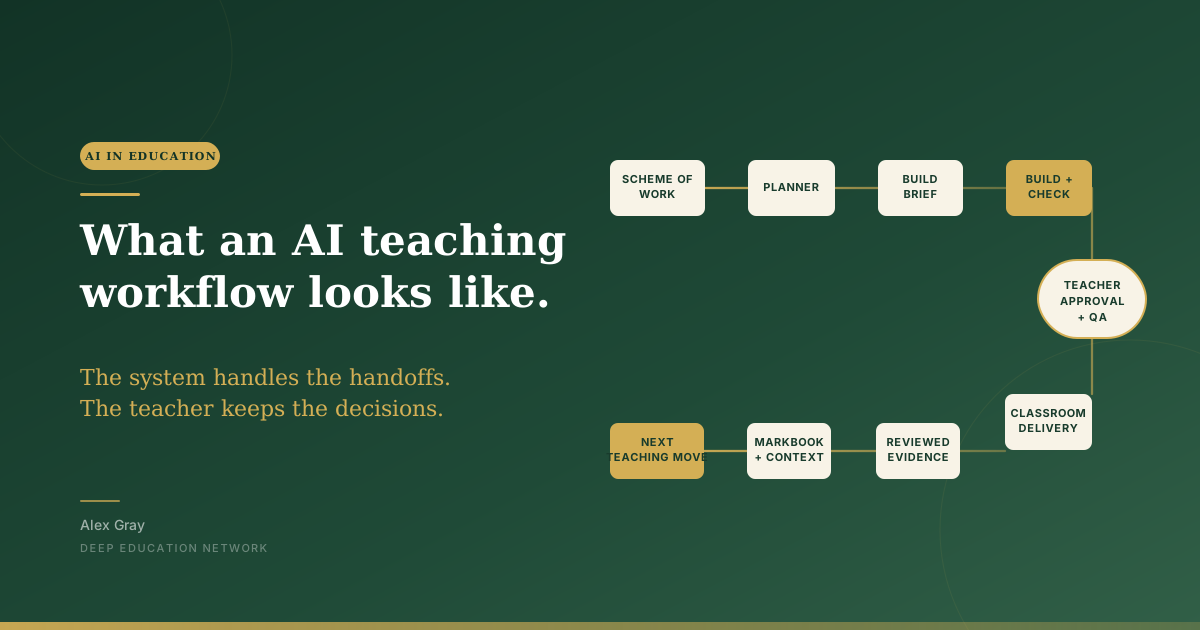
AI-driven tools like Gradescope are automating the grading process, reducing the time teachers spend on evaluating student work. This means teachers have more time to provide personalised feedback and support for their students. Similarly, AI-powered lesson planning tools can generate custom lesson plans based on a teacher's specific needs, streamlining the planning process and ensuring that lessons are tailored to individual students.
Moreover, AI can provide teachers with valuable insights into student performance, helping them identify struggling students and adjust their teaching strategies accordingly. By leveraging AI, teachers can make more informed decisions and deliver more effective instruction. Explore how to rethink your lesson plans for the AI revolution.
The Importance of AI Literacy for Educators
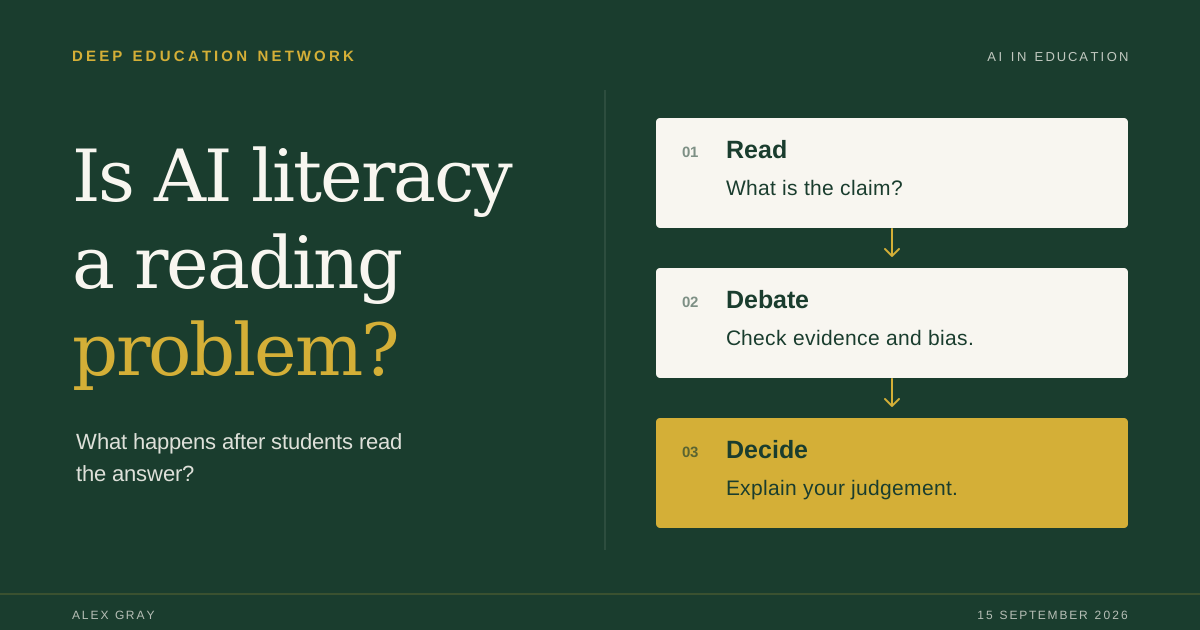
As AI becomes more embedded in educational tools and platforms, a new form of professional literacy is emerging: the ability to understand, evaluate, and effectively use AI systems in educational contexts. This is not about turning every teacher into a data scientist. It is about ensuring that educators have sufficient understanding of how AI tools work to make informed decisions about when and how to use them.
AI literacy for educators encompasses several dimensions. At a foundational level, teachers benefit from understanding what large language models are, how they generate outputs, and why they sometimes produce confident but incorrect information. This knowledge helps teachers set appropriate expectations for both themselves and their students and to design activities that leverage AI's strengths while accounting for its limitations.
Beyond technical understanding, AI literacy includes the ability to evaluate AI tools against pedagogical criteria. Not every AI-powered product is educationally sound, and the marketing language surrounding EdTech can make it difficult to distinguish genuinely useful tools from those that are technically impressive but pedagogically shallow. Teachers who understand the principles of effective instruction are well positioned to make these judgements -- but they need time, training, and institutional support to do so.
Schools that prioritise AI literacy as part of their professional development programmes will be better equipped to navigate the rapidly changing landscape of educational technology. Those that leave individual teachers to figure things out on their own risk fragmented adoption, inconsistent practice, and missed opportunities to genuinely improve student outcomes.
Tech-Transformed Classrooms: Augmented Reality, Virtual Reality, and Beyond
The classroom is no longer limited to four walls and a chalkboard. Emerging technologies like Augmented Reality (AR) and Virtual Reality (VR) are opening up new dimensions in education, bringing learning to life in ways never thought possible.
Imagine students exploring ancient ruins through a VR headset or dissecting a virtual frog using AR. These immersive experiences are not only captivating but also significantly improve understanding and retention. By leveraging AR and VR, educators can create hands-on, interactive lessons that keep students engaged and motivated.
The Equity Question: Who Benefits from AI in Education?
While the potential of AI in education is significant, it is essential to ask who stands to benefit -- and who risks being left behind. The UNESCO Global Education Monitoring Report has repeatedly highlighted that technology in education can either narrow or widen existing inequalities, depending on how it is implemented.
In well-resourced schools with strong internet connectivity, trained staff, and supportive leadership, AI tools can genuinely enhance teaching and learning. But in under-resourced contexts -- which represent the majority of schools globally -- the same tools may be inaccessible, poorly implemented, or used without adequate teacher preparation. The risk is that AI becomes another dimension of the digital divide rather than a bridge across it.
For educators in international school contexts, this equity question takes on additional dimensions. Many international schools serve families with high levels of digital access at home, but the same cities may have local schools where students share a single device among an entire class. Schools that position themselves as leaders in AI-integrated education have a responsibility to consider how their practices might be shared more broadly -- through partnerships, open resources, or community engagement programmes.
The OECD's work on AI in education offers a useful framework here: AI tools should be evaluated not only on their technical capabilities but on their potential to promote equity, inclusion, and access. A tool that works brilliantly for confident, high-achieving students but offers nothing for struggling learners is not truly transformative -- it simply amplifies existing advantages.
Comparing AI Applications Across Education Contexts
AI is being applied in education in a variety of ways, and not all applications are equally mature or effective. The following table provides an overview of the current landscape.
| AI Application | Maturity Level | Primary Benefit | Key Limitation | Example Tools |
|---|---|---|---|---|
| Adaptive learning platforms | High | Personalised practice at scale | Often limited to STEM subjects | ALEKS, Century Tech, Khan Academy |
| Automated essay scoring | Moderate | Fast feedback on writing | Struggles with creativity and nuance | Turnitin, Grammarly, Writable |
| AI tutoring chatbots | Moderate | 24/7 student support | Can provide inaccurate information | Khanmigo, ChatGPT, Gemini |
| Lesson planning assistants | Emerging | Saves teacher preparation time | Outputs require significant refinement | MagicSchool, Eduaide.AI |
| Predictive analytics (student risk) | Moderate | Early intervention for at-risk students | Ethical concerns around surveillance | BrightBytes, Civitas Learning |
| AR/VR learning experiences | Emerging | Immersive, memorable experiences | High cost, limited curriculum coverage | Google Arts & Culture, Merge EDU |
This landscape is evolving rapidly, and new tools are appearing regularly. The most important thing for educators is not to adopt every new tool but to develop the professional judgement to evaluate which tools genuinely serve their students and which are solutions in search of a problem.
The Future of Education: A Seamless Blend of AI and Human Interaction
As technology continues to advance, it's crucial to remember that AI is not meant to replace teachers but rather to enhance their capabilities. A blend of AI-driven tools and human interaction is essential to create an optimal learning environment.
In the future, we can expect to see AI playing a more significant role in the classroom, assisting teachers and students alike. From personalised learning experiences to streamlined administrative tasks, AI is truly revolutionising education and transforming the classroom. If you want to start building your AI skills, check out our Think with AI course.
Conclusion: Progress Requires Intentionality, Not Just Technology
The integration of AI into education has already begun to transform the classroom in meaningful ways. Personalised learning platforms are helping students learn at their own pace. Administrative tools are freeing teachers to focus on what matters most. Immersive technologies are making abstract concepts tangible. These are genuine advances, and they deserve our attention.
However, technology alone has never transformed education. Every previous wave of educational technology -- from overhead projectors to interactive whiteboards to tablets -- has followed a similar pattern: initial excitement, uneven implementation, and eventual recognition that the technology is only as effective as the pedagogy behind it. AI will be no different. The tools are more powerful than anything we have seen before, but the fundamental challenge remains the same: using them in ways that genuinely improve learning for all students, not just those who are already well served.
For educators, this means approaching AI with informed optimism rather than uncritical enthusiasm. It means investing in professional development, evaluating tools against evidence rather than marketing claims, and keeping student wellbeing and equity at the centre of every adoption decision. The future of education is not about replacing human interaction with artificial intelligence -- it is about finding the right balance between the two, so that every student has the opportunity to learn, grow, and thrive in a world where both human and artificial intelligence play important roles.
Filed under

Stay in the Loop
Get practical insights about AI in education, new articles, and training updates delivered to your inbox.
No spam. Unsubscribe anytime.
Work With Alex
Looking for hands-on support with AI integration, curriculum design, or teacher professional development? Alex works with schools and organisations worldwide to build practical, evidence-informed approaches to education technology.