

AI is transforming classrooms — here's how to redesign your lesson plans to harness it effectively and responsibly.
In the dynamic digital age, educators globally are feeling the nudge to upgrade their teaching techniques. The buzzword? Artificial Intelligence (AI). Yet, as with any new tool, the challenge is in weaving it seamlessly into our teaching fabric. So, how can teachers redesign their lesson plans to incorporate AI-driven student tasks? Buckle up; we're diving deep!
A traditional lesson plan
Traditional lesson plans have been a staple in education for decades. They typically follow a structured format, outlining the objectives, activities, and assessments for each class session. While these plans provide a clear roadmap for teachers, they often lack the flexibility and adaptability needed to meet the diverse learning needs of students.
It's time to rethink our lesson planning strategies and embrace the possibilities that AI brings to the table. By incorporating AI tools and platforms into our lessons, we can create more dynamic and interactive learning experiences that cater to individual student needs.
But what exactly does this look like? How can we utilise AI in our classrooms? Let's dive deeper into rethinking your lesson plan with the power of artificial intelligence!
Rethinking lesson plans for utilising AI
The First Step? Exploration.
Before you can weave AI magic into your lessons, you need to understand the tools at your disposal. Moving from AI-wareness to AI-mazing starts with exploration. Start with beginner-friendly platforms like ChatGPT, Google Gemini (formerly Bard, rebranded in February 2024), Leonardo and Microsoft Copilot. Explore ways you can integrate AI into your teaching strategies while keeping student engagement at the forefront of your efforts.
Purpose Drives Integration.
It's tempting to use AI because it's "cool", but purpose should always guide integration. Using a framework like TPACK can help ground your decisions. Whether it's understanding Shakespearean language or dissecting frog anatomy, ask yourself: "How can AI tools make this clearer, more engaging, or more interactive for my students?"
Engage, Experiment, Explore.
AI shines brightest when students get hands-on. Have a look at these examples from Chris Goodall and Matthew Wemyss on LinkedIn on how they are giving AI tasks and activities to students.
AI Isn't Always Right. Challenge It!
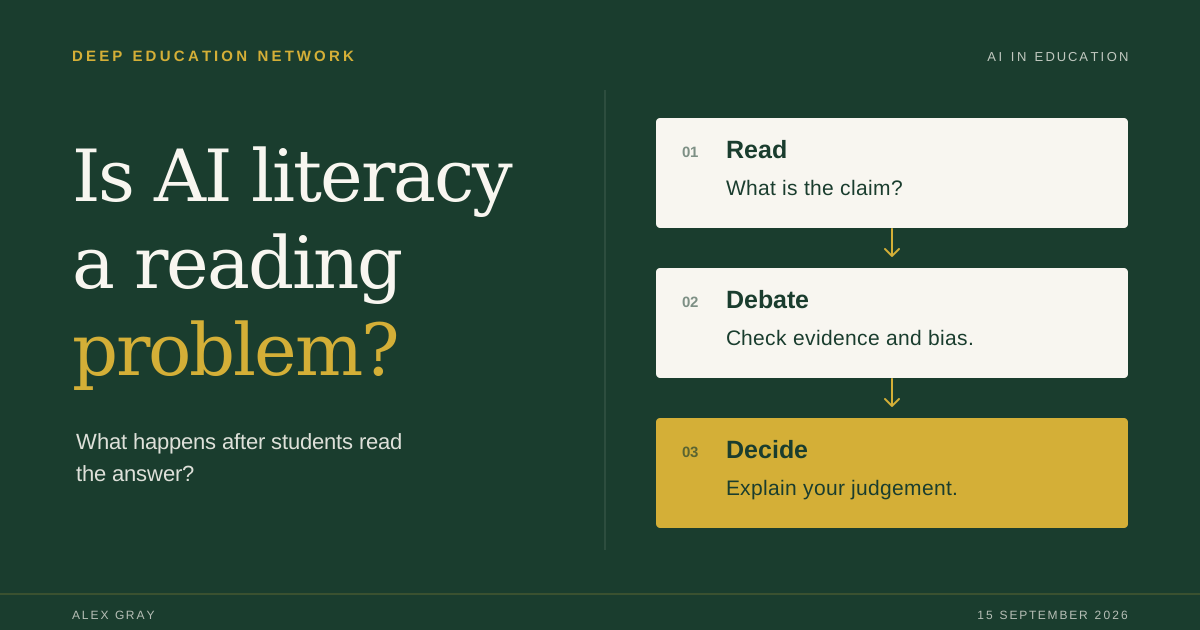
A fascinating way to enhance critical thinking is by juxtaposing AI-generated content with original sources. In a literature class, comparing AI-generated plot summaries with the actual text can lead to deep discussions about nuances and interpretations. My video on WAGOLLs is a good example for this.
Balance is the Key.
While AI offers new avenues, traditional teaching methods have their irreplaceable merits. Maybe start a history lesson with a traditional documentary and then use AI tools to simulate an interview with a historical figure. The juxtaposition can be both enlightening and engaging.
What the Evidence Says About AI-Enhanced Lesson Design
Before diving further into practical strategies, it is worth grounding our approach in what the research tells us about effective technology integration in lessons. The enthusiasm for AI in education is understandable, but not every use of technology improves learning -- and some uses can actively detract from it.
The Education Endowment Foundation's (EEF) guidance on digital technology identifies several conditions under which technology integration is most likely to improve student outcomes. First, the technology must support a clear pedagogical goal rather than being added for its own sake. Second, teachers need sufficient training and confidence to use the tools effectively. Third, the technology should complement rather than replace high-quality teacher-student interaction.
These principles apply directly to AI integration. A lesson that asks students to generate an essay using ChatGPT and then submit it has little pedagogical value. A lesson that asks students to generate three different AI responses to the same essay question, evaluate their strengths and weaknesses against a rubric, and then write their own improved version is a fundamentally different activity -- one that develops critical thinking, evaluation skills, and subject knowledge simultaneously.
UNESCO's guidance on generative AI in education (2023) reinforced this point, recommending that AI tools in classrooms should be used to "augment human capabilities" rather than to "automate learning." The distinction is subtle but crucial: augmentation means the student remains the active thinker, with AI serving as a tool to extend their capabilities. Automation means the AI does the thinking, and the student becomes a passive recipient of its output.
A Practical Framework: The AI Lesson Integration Spectrum
When redesigning lesson plans to include AI, it helps to think in terms of a spectrum rather than a binary choice between "uses AI" and "does not use AI." The following table outlines four levels of AI integration, from basic to transformative.
| Level | Description | Example Activity | Student Role | Learning Value |
|---|---|---|---|---|
| Substitution | AI replaces a non-digital tool with no functional change | Using AI to look up definitions instead of a dictionary | Consumer | Low -- no new learning affordance |
| Augmentation | AI adds functional improvement to existing task | Using AI to generate a first draft, then revising with teacher feedback | Editor/reviser | Moderate -- saves time, enables focus on higher-order skills |
| Modification | AI enables significant task redesign | Students debate an AI-generated argument, identifying logical flaws | Critical evaluator | High -- develops analytical and evaluative thinking |
| Redefinition | AI enables tasks previously inconceivable | Students co-create a multilingual resource with AI, testing it with partner schools globally | Creator/collaborator | Very high -- new forms of learning become possible |
This framework is adapted from the well-known SAMR model (Puentedura, 2006) and applied specifically to AI tools. The goal is not to operate at the "redefinition" level in every lesson -- that would be exhausting and impractical. Rather, it is to be intentional about which level you are operating at and to ensure that over the course of a unit, students experience AI integration at multiple levels.
Team Up and Train Up.
Divide students into groups, give each a dataset, and let them train a basic AI model. The collaborative spirit combined with the allure of tech can create a memorable learning experience. Plus, it's an excellent avenue for peer-led learning.
Instant and Insightful.
AI-driven tools, especially in languages, offer instantaneous feedback. Students can get real-time corrections, accelerating their learning curve. Encourage them to reflect on this feedback, transforming mistakes into lessons.
Tech Responsibility.
In a world increasingly run by algorithms, students must understand AI's ethical side. Our Think with AI course explores this in depth. Initiate discussions on AI biases, data privacy, and potential societal impacts. It's not just about using AI but understanding its broader implications.
Learn from Learners.
After an AI-integrated lesson, gather student feedback. Their insights can be golden, helping you refine your approach and making AI integration smoother and more effective.
Starting Small: A Suggested First AI Lesson
If the range of possibilities feels overwhelming, here is a concrete starting point. Choose a lesson you already teach well -- one where you are confident in the learning objectives and know the common misconceptions students encounter. Then add a single AI-enhanced activity.
For example, in a Year 9 English lesson on persuasive writing, you might ask students to prompt ChatGPT or Gemini to write a persuasive letter on a given topic. Students then evaluate the AI's output against a success criteria checklist they have already been using in class. Where does the AI succeed? Where does it fall short? What rhetorical devices does it use -- or miss? Students then write their own version, aiming to outperform the AI.
This single activity touches multiple learning objectives: understanding persuasive techniques, evaluating writing quality, and producing their own improved text. It also introduces students to AI as a tool to be critically assessed rather than blindly trusted. And crucially, it slots into your existing lesson structure without requiring you to redesign everything from scratch.
Once you have tried one AI-enhanced activity and reflected on what worked, you can gradually expand. The key is iteration, not revolution. The best AI-integrated lessons I have seen in schools were not designed in a single burst of inspiration but refined over several teaching cycles based on student response and teacher reflection.
Conclusion
Incorporating AI into a lesson plan would naturally introduce new elements to the structure, but the core tenets of effective lesson planning—clarity, engagement, assessment, and reflection—remain intact. The integration of AI tools aims to make the learning experience more interactive, personalised, and enriched. The seamless blending of traditional teaching methods with cutting-edge technology can offer students a richer, more immersive learning experience — but as we explore in why your AI tool still feels like a digital worksheet, the key is moving beyond substitution to genuine transformation.
Considering the changing landscape of education and the tools at our disposal, do you believe your current lesson plans fully harness the potential of AI and other emerging technologies? If not, what changes might you envision for a more enriched, tech-integrated classroom experience?

Stay in the Loop
Get practical insights about AI in education, new articles, and training updates delivered to your inbox.
No spam. Unsubscribe anytime.
Work With Alex
Looking for hands-on support with AI integration, curriculum design, or teacher professional development? Alex works with schools and organisations worldwide to build practical, evidence-informed approaches to education technology.