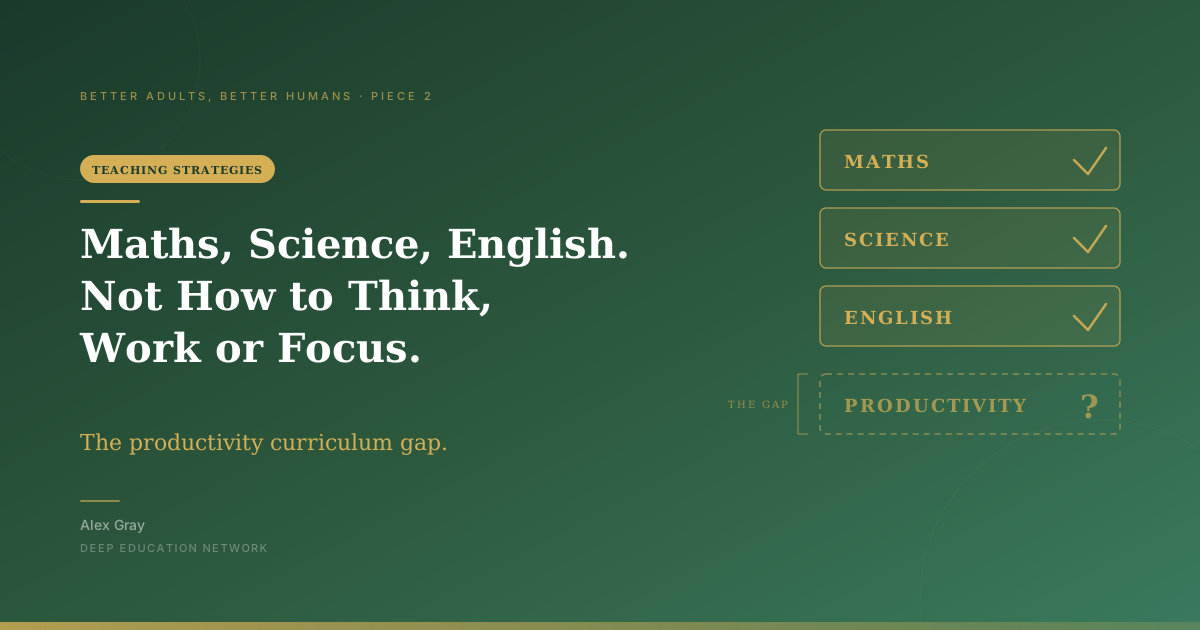

The only productivity advice I got in thirteen years of school was two words: work hard. Here are the five capacities that actually sit underneath productive work, the evidence behind each, and the uncomfortable question of where young people are meant to learn them.
The only productivity advice I received in thirteen years of schooling was two words: work hard.
Nobody explained what working hard actually meant. Nobody distinguished between an hour of focused effort and an hour of anxious busyness. Nobody mentioned that the quality of attention you bring to work matters more than the time you spend at it, or that motivation has an anatomy, or that the environment you work in is making decisions for you whether you notice or not.
Work hard. That was the curriculum.
I have spent the last few years correcting that education in public, reading the research I should have been handed at sixteen, and building systems to compensate for the skills nobody taught me. This piece is an attempt to organise what I have found into something useful: the five capacities that productive work actually requires, the evidence behind each one, and the uncomfortable question of where young people are supposed to develop them.
Productive work has an anatomy
Strip away the hustle culture and the app recommendations and the morning routines of billionaires, and the research points to five distinct capacities that sit underneath all genuinely productive work.
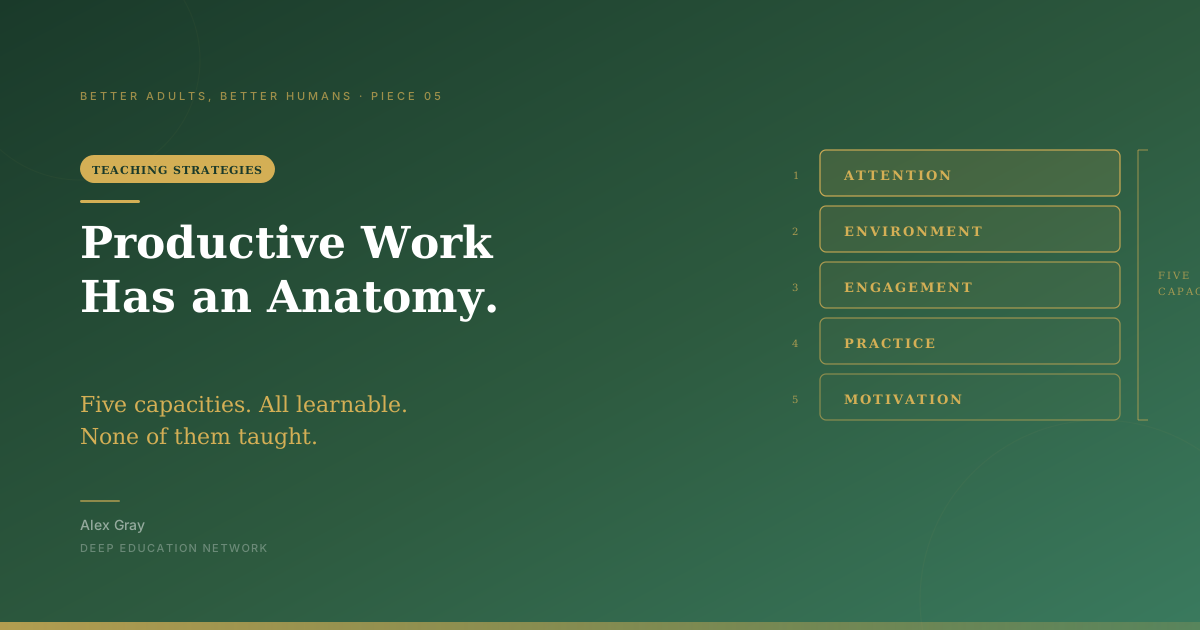
The capacity to sustain attention on demanding tasks. The capacity to design environments and habits that protect that attention. The capacity to find genuine engagement in effort. The capacity to practise deliberately at the edge of your ability. And the capacity to connect work to motivation that does not collapse the moment external pressure disappears.
Five capacities. All learnable. None taught.
Capacity one: sustained attention
Cal Newport calls it deep work: professional activity performed in a state of distraction-free concentration that pushes cognitive capability to its limit. His argument is that this capacity is becoming simultaneously rarer and more valuable, and that most knowledge workers have quietly lost it without noticing.
The mechanism that destroys it is something Newport calls attention residue. When you switch tasks, part of your attention stays behind on the previous task. It does not transfer cleanly. Check your email mid-task and a fragment of your cognition is still processing that email twenty minutes later. A day of constant switching is a day spent thinking with a fraction of your actual capacity.
The practical implication is unfashionable: productive work requires long, protected, uninterrupted blocks. Not better multitasking. Not faster switching. The deliberate defence of unbroken time.
I did not learn this until my thirties. Most adults never learn it at all.
Capacity two: designed environments
James Clear's contribution in Atomic Habits is the insight that behaviour is not primarily a product of motivation. It is a product of environment and identity. You do not rise to the level of your goals. You fall to the level of your systems.
The application to productive work is direct. The person who focuses consistently is not more disciplined than you. They have designed a working environment where focus is the path of least resistance: phone in another room, notifications off, the work already open before they sit down. The friction is doing the work that willpower cannot sustain.
Clear pairs this with identity: lasting behaviour change starts with who you believe you are, not what you want to achieve. Not "I want to focus more" but "I am someone who protects my attention." Every action in line with that identity is a vote for it. The habits compound from there.
When I built The Brief, my own productivity system, this was the principle underneath it. I do not trust my morning self to make good decisions about what matters. So the night before, the decision is already made. The environment decides so motivation does not have to.
Capacity three: genuine engagement
Mihaly Csikszentmihalyi spent his career studying the state he named flow: complete absorption in a task that is challenging enough to demand your full capability but not so difficult that it overwhelms it. Clear goals, immediate feedback, and a challenge-skill balance. When those conditions align, effort stops feeling like cost and starts feeling like reward.
Two findings from his research deserve more attention than they get. The first is that flow is the opposite of distraction: a person in genuine flow does not need willpower to stay on task, because the task itself has captured them. The second is the paradox of work and leisure: people report more flow at work than in passive leisure, yet consistently say they would rather be relaxing. We are measurably happier in absorbed effort than in consumption, and we keep choosing consumption anyway.
The productive person is not the one who grinds through resistance indefinitely. It is the one who has learned to construct the conditions of engagement: clear goals, feedback loops, and challenges calibrated to their current skill. That is a designable state, not a lucky one.
Capacity four: deliberate practice
Anders Ericsson's research on expertise dismantled the most comforting myth in education: that ability is mostly talent and time. What produces expert performance, across every domain he studied, is deliberate practice. Focused, effortful work at the edge of current ability, with immediate feedback, repeated over time.
The word doing the work in that sentence is deliberate. Naive practice, repeating what you can already do, produces almost no growth regardless of hours invested. The ten thousand hours framing that escaped into popular culture missed Ericsson's actual point: it is not the hours, it is the quality and intentionality of attention inside them.
I have lived this one recently. I learned full-stack development in my forties with no coding background, and the learning only moved when I worked at the edge: building things slightly beyond my ability, failing visibly, getting immediate feedback, and going again. Comfortable repetition taught me nothing. Calibrated struggle taught me everything.
Notice what deliberate practice requires: sustained attention, a designed environment, and engagement with difficulty. The capacities stack. None of them works alone.
Capacity five: motivation that lasts
Daniel Pink's synthesis of the motivation research in Drive identifies the three conditions under which human beings work with genuine commitment: autonomy, the sense of directing your own work; mastery, the experience of getting better at something that matters; and purpose, the connection between effort and something larger than yourself.
The inverse finding matters just as much. External rewards and pressure, the if-then incentives that schools and workplaces run on, actively degrade performance on cognitive and creative tasks. They narrow focus, crowd out intrinsic interest, and produce compliance instead of commitment.
This is the capacity that holds the other four together. Attention, environment, engagement, and practice all require effort that must be renewed daily. Externally imposed motivation cannot renew it. Only work connected to autonomy, mastery, and purpose sustains the rest of the system.
The architecture problem
There is a sixth element, and it is structural rather than personal. Paul Graham's essay on the maker's schedule and the manager's schedule describes two incompatible ways of organising time: hourly slots for reactive work, and long blocks for deep work. Genuine cognitive effort requires the second. Almost every institution, including every school I have worked in, is built on the first.
This matters because the five capacities cannot be exercised inside an architecture that prevents them. You cannot practise sustained attention in a day diced into reactive fragments. The skills and the schedule have to be built together.
So where do students learn this?
Here is the honest answer: at the moment, mostly nowhere.
The curriculum does not teach it, as I argued in Schools Don't Teach Productivity. The timetable actively models its opposite. And the adults in young people's lives largely never developed these capacities themselves, because nobody taught them either.
Which leaves one viable path, and it is the thesis of this whole series. Young people will learn these skills from adults who have built them first. Not from adults who lecture about focus while fragmenting their own days. From adults whose working lives quietly demonstrate what sustained attention, designed environments, genuine engagement, deliberate practice, and intrinsic motivation actually look like.
Bandura's research, which a later piece takes up properly, shows that this is how most significant learning transmits anyway: through observation, not instruction. The five capacities are caught before they are taught.
The question worth sitting with
So the practical question for any adult who works with young people is not "how do I teach my students to be productive?" It is:
Which of these five capacities have I actually developed, and which am I currently modelling the absence of?
That question stung when I first asked it of myself. It is also the most useful place to start.
This is the fifth piece in the Better Adults, Better Humans series, which argues that the skills we most want for young people — focus, rest, productive work, a full life — are caught from the adults around them before they are ever taught.
Read Piece 1: Your Students Can't Focus. Neither Can You., Piece 2: Schools Don't Teach Productivity, Piece 3: Better Humans — Why Every Educator Needs a Rest Ethic, and Piece 4: Seven Types of Rest, and Why Sleep Only Fixes One, or browse the full series.
Frequently asked
What are the five productivity skills? Sustained attention (deep work), designing environments and habits that protect that attention, finding genuine engagement in effort (flow), deliberate practice at the edge of your ability, and motivation that lasts because it is built on autonomy, mastery and purpose. The argument here is that all five are learnable, and that schools teach none of them directly.
Why don't schools teach productivity skills? The curriculum has no subject for them, the timetable models their opposite by dicing the day into reactive fragments, and most of the adults teaching never developed the capacities themselves because nobody taught them either. The skills and the school schedule were never built together.
Where do students actually learn to focus and work well? Mostly from observation rather than instruction. Bandura's research on social learning suggests these capacities are caught from adults who genuinely model them — not from adults who lecture about focus while fragmenting their own days.
What is the difference between deliberate practice and just practising? Naive practice repeats what you can already do and produces almost no growth regardless of hours. Deliberate practice is focused, effortful work at the edge of your current ability with immediate feedback. Anders Ericsson's point was never about ten thousand hours — it was about the quality and intentionality of the attention inside them.
Further reading
- Cal Newport, Deep Work (2016). Sustained attention as the defining professional skill, and attention residue as the mechanism that destroys it.
- James Clear, Atomic Habits (2018). Identity and environment design as the real drivers of behaviour.
- Mihaly Csikszentmihalyi, Flow (1990). The conditions of complete engagement, and why we are happier in effort than in consumption.
- Anders Ericsson, Peak (2016). Deliberate practice and the dismantling of the talent myth.
- Daniel Pink, Drive (2009). Autonomy, mastery and purpose as the anatomy of lasting motivation.
- Paul Graham, Maker's Schedule, Manager's Schedule (2009). Why deep work is structurally incompatible with how most institutions organise time.
Filed under

Stay in the Loop
Get practical insights about AI in education, new articles, and training updates delivered to your inbox.
No spam. Unsubscribe anytime.
Work With Alex
Looking for hands-on support with AI integration, curriculum design, or teacher professional development? Alex works with schools and organisations worldwide to build practical, evidence-informed approaches to education technology.