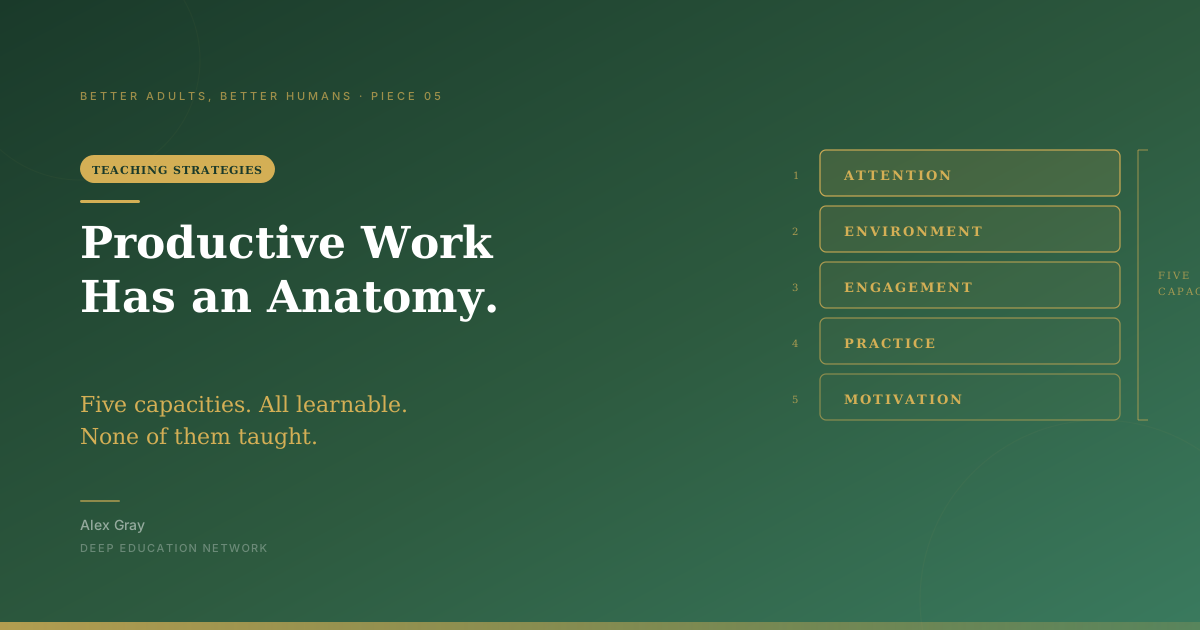

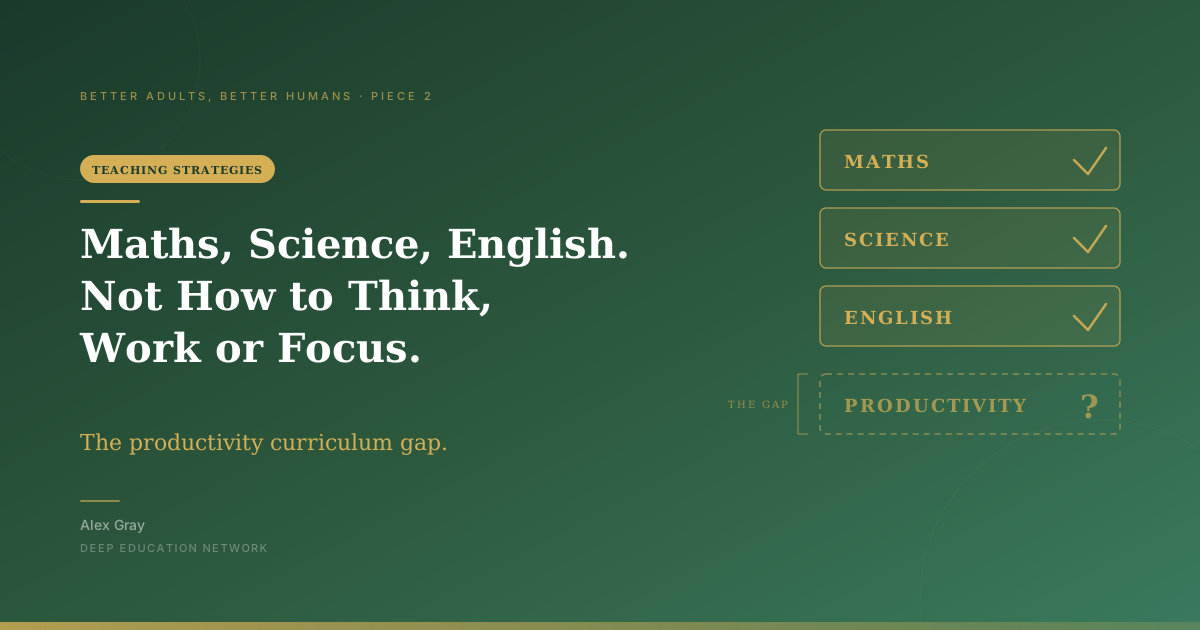
There is a word for the collection of skills that determines how well a person thinks, works and performs over a lifetime. It is not on any curriculum. The word is productivity, and the gap is one of the most consequential in modern schooling.
Think about everything you were taught before you left school.
Quadratic equations. The water cycle. The causes of the First World War. How to structure an essay, calculate a percentage, conjugate a verb in a foreign language.
Now think about what you were never taught.
How to structure a day of difficult thinking. How to decide what to work on first when everything feels urgent. How to sit with a hard problem long enough for genuine understanding to develop rather than reaching for the fastest exit. How to protect your best cognitive hours from the things that will consume them if you do not actively decide otherwise.
Nobody taught you any of that. And if you are honest, you are still working it out.
The gap nobody named
There is a word for the collection of skills that determines how well a person thinks, works, and performs over a lifetime. It is not on any curriculum. It is not assessed at GCSE or A level. It does not appear in any school development plan I have ever read.
The word is productivity. Not in the shallow, hustle-culture sense of doing more faster. In the serious sense: the capacity to direct your cognitive resources towards what actually matters, sustain effort on difficult tasks, and produce work that reflects your genuine capability rather than the fraction of it you happened to have available on the day.
By every meaningful measure, this is one of the most important skills a young person will need as an adult. And we have collectively decided not to teach it.
Not because we examined the evidence and concluded it did not matter. Because nobody ever asked the question.
What the research actually shows
Professor Gloria Mark at UC Irvine has spent two decades measuring how people actually deploy their attention at work. The average adult switches tasks every three to five minutes. After a single digital interruption, it takes twenty-three minutes to return to full cognitive focus.
These are not numbers about distracted teenagers. They are numbers about adults in professional environments, people who left school with qualifications, moved into careers, and were never given a single lesson in how to manage the resource that determines the quality of everything they produce.
The cost is not abstract. It shows up in decisions made on depleted thinking. In creative work that never reaches its potential because the conditions for deep thought were never protected. In the chronic low-level exhaustion of people who are technically busy all day and genuinely productive for perhaps two hours of it.
Daniel Pink's research in Drive makes the case that human beings are intrinsically motivated by three things: autonomy, mastery, and purpose. When people have genuine ownership over their work, are developing genuine competence, and connect what they do to something that matters, motivation is not a management problem. It solves itself.
But mastery requires sustained, focused effort. Autonomy requires knowing how to direct it. Purpose requires the clarity that only comes from uninterrupted thought. Strip away the capacity for deep work and all three collapse, not because the person lacks drive, but because the cognitive infrastructure to act on it was never built.
Cal Newport puts it plainly in Deep Work: the ability to focus without distraction on cognitively demanding tasks is becoming simultaneously more rare and more economically and intellectually valuable. It is also, critically, a skill. Not a personality trait. Not something you are born with or without. A learnable, developable capacity that responds to practice, environment, and intentional cultivation. We argued something similar in Your Students Can't Focus. Neither Can You., the first piece in this series.
We know this. The research is not new. And yet the response from education has been almost complete silence.
The maker's schedule problem
Paul Graham wrote an essay in 2009 that has stayed relevant in every year since. He described two fundamentally different ways of organising a working day: the manager's schedule, built around hourly slots and meetings, reactive and fragmented by design; and the maker's schedule, built around long uninterrupted blocks where deep thinking actually happens.
A single meeting, Graham observed, can destroy a maker's productive day. Not because of its length but because of what it does to the cognitive blocks around it. The anticipation fragments the morning. The recovery costs the afternoon. A day of three meetings is not three hours of meetings and five hours of work. It is three hours of meetings and a series of shallow, interrupted attempts at thinking that add up to something far less than five hours of real output.
Read that and then look at the structure of a school day.
Educators run the most extreme version of the manager's schedule imaginable. Lessons every hour. Registration. Duties. Emails between. Meetings after. A timetable that makes sustained deep thought structurally impossible for most of the working week. And the young people sitting in those schools are watching that model, absorbing it as normal, and will carry it into their own working lives.
Nobody is to blame for this specifically. The timetable exists for legitimate reasons. But the result is that both the adults and the students in most schools have very little experience of what it feels like to think deeply about something for a sustained period without interruption. That is the condition under which genuine understanding, creativity, and problem-solving actually occur. And it is almost entirely absent from the formal experience of schooling.
Both the adults and the students in most schools have very little experience of what it feels like to think deeply about something without interruption. That is the condition under which genuine understanding occurs.
James Clear and the identity problem
The most useful reframe in Atomic Habits is not about habits at all. It is about identity.
Clear's argument is that sustainable behaviour change begins with a shift in how you see yourself. Not 'I am trying to focus more' but 'I am someone who protects their attention.' Not 'I want to be more productive' but 'I am someone who does the important work first.' The behaviour follows from the identity. Without the identity, the behaviour is a resolution waiting to collapse.
This matters for education because it identifies exactly what is missing from how we develop young people's relationship with their own cognition.
We tell students what to produce. We tell them when to produce it. We rarely tell them, and almost never help them practise, how to show up for the work itself. How to begin when beginning is hard. How to continue when the thinking gets uncomfortable. How to recover attention when it wanders, as it always will. The same identity gap shows up in teachers themselves, which is partly why repetition and habit can quietly lead even strong teachers to plateau.
The result is students who are competent at performing tasks within a structured external system and often significantly less capable the moment that structure is removed. Which is precisely the situation they face the moment they leave school.
Who is responsible for closing the gap
This is where the conversation usually ends. Everyone agrees the gap exists. The question of who should close it is where things get complicated.
It is not a single subject's responsibility. The skills of deep work, attention management, and deliberate practice are not English or science or PSHE. They cut across everything. Which is another way of saying they belong to no one, and so they tend to belong to no one in practice.
It is not something that can be outsourced to parents. Some young people have parents who model and teach these skills. Most do not, not because their parents are inadequate, but because their parents were never taught them either. The gap is generational. Expecting families to close it without support from schools is not a strategy. It is an abdication.
And it is not something that will be fixed by adding another subject to an already overcrowded curriculum. That is precisely the wrong instinct, because it treats productivity as content to be delivered rather than a capacity to be developed through how everything else is taught.
The serious answer is that developing the capacity for sustained thought, deliberate effort, and directed attention has to become a design principle for how school works, not an add-on to what school teaches.
That means protecting time for deep thinking rather than filling every moment with activity. It means teaching students explicitly what focused work feels like and how to return to it when the mind wanders. It means school leaders examining their timetables and asking honestly whether the structure of the day supports or systematically undermines the cognitive development it claims to prioritise.
It means, most uncomfortably, that the adults responsible for the curriculum have to develop these capacities in themselves first. You cannot design for deep thinking from a fragmented, reactive working life. You cannot teach students to manage their attention if nobody in the building has seriously grappled with managing their own.
The question school leaders need to sit with
At the end of thirteen years of compulsory education, a young person in this country can demonstrate knowledge of quadratic equations and the causes of historical events and the structure of a cell.
What they almost certainly cannot demonstrate is how to spend a day of difficult work well. How to protect the thinking that matters from the noise that does not. How to sit with cognitive discomfort long enough for genuine understanding to develop. How to show up for their own potential in the absence of a teacher telling them what to do next.
That is not a small gap. It is arguably the gap that determines more about the quality of an adult life than any qualification they leave with.
If we know this matters, and we know it is not being taught, what are we waiting for?
The question for anyone who designs, leads, or shapes what happens in schools is straightforward, if uncomfortable: if we know this matters, and we know it is not being taught, what are we waiting for?
This is the second piece in the Better Adults, Better Humans series, exploring what it means for adults to develop the capacities they need so they can model and build them in the next generation.
Read Piece 1: Your Students Can't Focus. Neither Can You., browse the full series, and listen to the companion conversation on The International Classroom podcast.
Frequently asked
Is productivity a teachable skill? Yes. The capacity for sustained attention, deep work and deliberate effort is a learnable skill, not a fixed trait. Decades of research from Cal Newport, Gloria Mark, James Clear and Daniel Pink all converge on the same point: it responds to practice, environment and intentional cultivation.
Why don't schools teach productivity? Because nobody ever asked the question. Productivity is not a single subject, so it falls between every subject. Adding another GCSE will not fix it. Developing the capacity for sustained thought has to become a design principle for how the school day is structured, not an extra topic bolted on to the curriculum.
What is the maker's schedule and why does it matter for teachers? The maker's schedule, named by Paul Graham in 2009, is a working day built around long uninterrupted blocks where deep thinking can actually happen. It is the opposite of the manager's schedule of hourly slots and meetings. School timetables are an extreme version of the manager's schedule, which is why both teachers and students rarely experience what real, sustained focus feels like.
Further reading
- Gloria Mark, Attention Span (2023). The research on interruption, task-switching, and the true cost of fragmented attention.
- Cal Newport, Deep Work (2016). The case for sustained focus as a learnable skill and its increasing value in professional life.
- James Clear, Atomic Habits (2018). Why identity-based habits outlast motivation-based ones, and what it means for how we develop capacity in young people.
- Daniel Pink, Drive (2009). The science of intrinsic motivation and why autonomy, mastery and purpose require the cognitive infrastructure to act on them.
- Paul Graham, Maker's Schedule, Manager's Schedule (2009). A short essay that remains the clearest account of why deep thinking is structurally incompatible with the way most organisations, including schools, organise time.
Filed under

Stay in the Loop
Get practical insights about AI in education, new articles, and training updates delivered to your inbox.
No spam. Unsubscribe anytime.
Work With Alex
Looking for hands-on support with AI integration, curriculum design, or teacher professional development? Alex works with schools and organisations worldwide to build practical, evidence-informed approaches to education technology.