
A practical guide for parents navigating AI in their child's education, from personalised learning to responsible usage.
As a parent, you've probably noticed how different your child's learning experience is from your own school days. Artificial Intelligence (AI) is transforming education, and understanding these changes is crucial for supporting your child's academic journey. If you are new to the topic, our AI 101: What Counts as AI course is a good starting point.
What Does AI in Education Actually Look Like?
Think of AI as a smart teaching assistant that works alongside traditional education. Here's what this means for your child:
-
Personalised Learning: Just as you might adjust your teaching style when helping your child with homework, AI adapts to how your child learns best. If they're struggling with fractions, the software might show more visual examples or offer extra practice problems.
-
Immediate Feedback: No more waiting days for test results. AI tools can instantly tell your child if they're on the right track, helping them learn from mistakes in real-time.
-
Interactive Learning: Remember struggling to visualise historical events or scientific concepts? AI-powered tools can create interactive experiences that bring these subjects to life.
How AI Helps Different Types of Learners
Every child learns differently, and this is where AI truly shines:
-
For visual learners: AI can generate diagrams and animations.
-
For hands-on learners: Interactive simulations and virtual labs make concepts tangible.
-
For students who need extra time: Adaptive programs that move at their pace provide a customised learning experience.
-
For children with learning differences: Tools that convert text to speech, offer focus assistance, or provide alternative learning methods make content more accessible.
Preparing Your Child for an AI-Enhanced Future
Your child will enter a workforce where AI is as common as computers are today. Here's how to help them prepare:
-
Encourage Critical Thinking: Help them understand when to use AI tools and when to rely on their own skills. Our Think with AI course explores this balance in depth.
-
Promote Creative Problem-Solving: AI is great at calculations, but human creativity remains invaluable.
-
Teach Responsible Usage: Show them how to fact-check -- skills covered in our Fact or Fiction course -- and use AI ethically and responsibly.
Common Parent Concerns Addressed
We hear these questions often from parents like you:
"Will AI make my child rely too much on technology?"
- Balance is key. Think of AI like a calculator – it's a tool to enhance learning, not replace thinking.
"What about online safety and privacy?"
-
Look for educational AI tools that prioritize student privacy.
-
Set clear guidelines for online activity.
-
Stay involved in your child's digital learning journey.
"How do I know if my child is actually learning?"
-
Partner with teachers to understand how AI tools are being used in class.
-
Ask your child to explain concepts in their own words.
-
Look for improvements in understanding, not just test scores.
Understanding the Research: What Studies Tell Parents
It is reasonable for parents to want evidence before embracing AI in their child's education. The good news is that a growing body of research supports the careful use of AI-powered learning tools, while also highlighting important caveats.
A meta-analysis published by UNESCO in 2023 found that AI-assisted personalised learning can improve student outcomes, particularly for learners who are behind their peers. The key finding was not that AI replaces good teaching, but that it can provide the kind of individual attention that is difficult for one teacher to deliver across a class of thirty students. Adaptive platforms that adjust difficulty in real time have shown measurable improvements in mathematics and reading comprehension, especially for primary-age children.
However, the same research cautioned that not all AI tools are created equal. Products designed with input from educators and learning scientists tend to outperform those built purely by technologists. As a parent, one practical step is to ask your child's school which tools they use and whether those tools have been evaluated for educational effectiveness -- not just engagement metrics.
The OECD's Digital Education Outlook 2023 also highlighted that parental involvement remains one of the strongest predictors of positive outcomes when technology is introduced into learning. Children whose parents take an active interest in their digital learning -- asking questions, setting boundaries, and co-exploring tools -- consistently outperform those left to navigate these tools alone. This is encouraging: it means that your engagement as a parent is not made less important by AI but rather more important.
Comparing Common AI Learning Tools
With so many AI-powered education tools available, it can be difficult to know what each one does. Here is a simplified comparison of some commonly used platforms and what they offer:
| Tool | Age Range | What It Does | Free Tier | Privacy Considerations |
|---|---|---|---|---|
| Khan Academy (Khanmigo) | 5-18 | AI tutor for maths, science, humanities | Limited free access | Strong student privacy policies |
| Duolingo | 6+ | Language learning with adaptive exercises | Yes | Collects usage data; COPPA compliant |
| Century Tech | 8-18 | Adaptive learning across subjects | School licence only | GDPR compliant; UK-based |
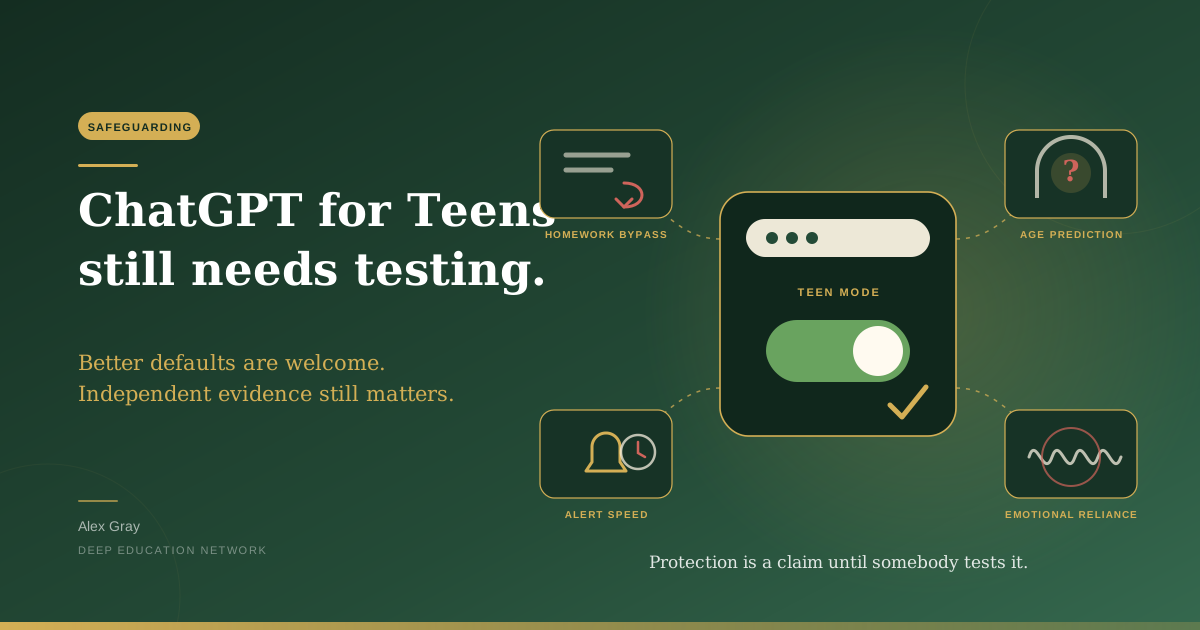
| ChatGPT (OpenAI) | 13+ (terms of service) | General-purpose AI assistant | Yes | Not designed for children; no COPPA compliance |
| Google Read Along | 5-10 | Reading practice with AI speech recognition | Yes | Minimal data collection |
| Photomath | 10+ | Step-by-step maths problem solving | Yes | Standard data collection |
This table is not exhaustive, and new tools appear regularly. The most important thing to check is whether the tool your child uses has a clear privacy policy, is age-appropriate, and is being used within a structured educational context rather than as unsupervised screen time.
Practical Conversations to Have at Home
One of the most powerful things parents can do is normalise conversations about AI at home. This does not require technical expertise -- it requires curiosity and a willingness to learn alongside your child.
Start with simple questions: "What did you use AI for at school today?" or "Can you show me how that app works?" These conversations serve multiple purposes. They keep you informed, they signal to your child that you take their digital learning seriously, and they create opportunities to discuss important topics like accuracy, bias, and appropriate use.
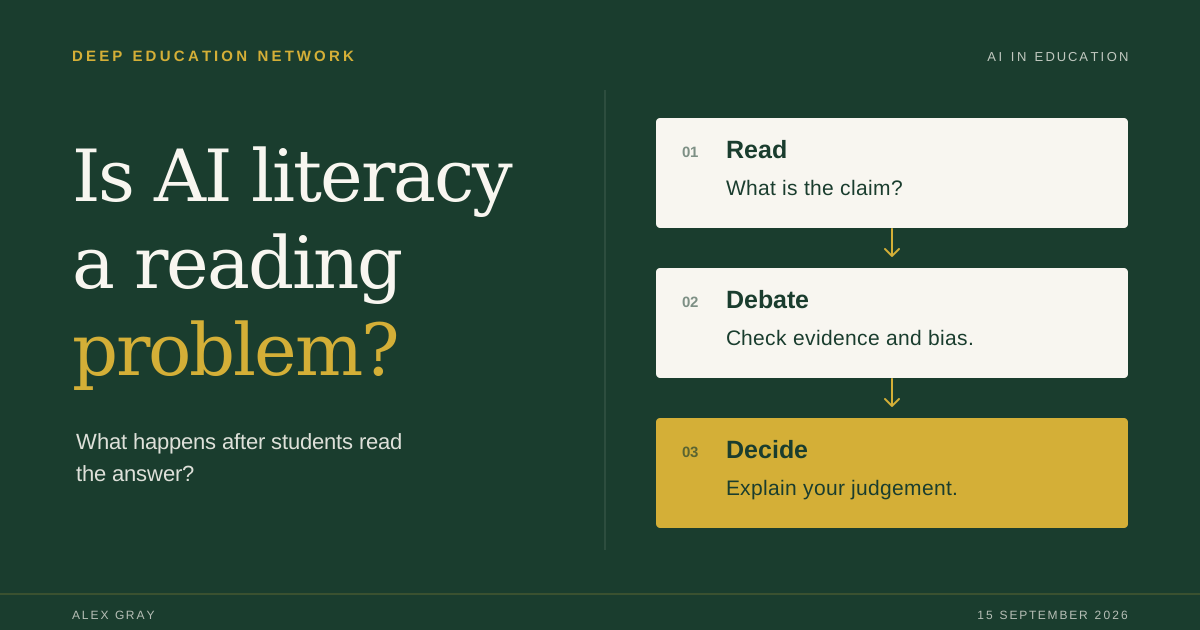
You might also consider using AI tools together as a family activity. Try asking a chatbot a question you already know the answer to and discuss how accurate or helpful the response is. This builds critical evaluation skills in an accessible, low-pressure way. Ask your child to spot what the AI got right and what it got wrong -- or what it left out entirely. These are the foundational critical thinking skills that will serve them well regardless of how the technology evolves.
It is also worth having an honest conversation about the limits of AI. Children who understand that AI models can produce plausible-sounding but incorrect information are better equipped to use these tools responsibly. Frame it positively: the ability to check, question, and verify is a superpower in an age of information abundance.
Conclusion: Your Role Matters More Than Ever
Understanding AI in education does not require a technical background -- it requires the same caring attention you already give to your child's education. For a deeper look at what schools should be doing, read our post on whether your school is AI-ready.
The most important takeaway for parents is this: AI will not diminish your role in your child's education. If anything, it amplifies it. As these tools become more sophisticated and more widespread, children will need informed, engaged adults who can help them navigate the opportunities and the pitfalls. That means asking questions, staying curious, setting reasonable boundaries, and modelling the kind of thoughtful technology use you want to see in your children.
The pace of change in AI is genuinely rapid, and it is natural to feel uncertain. But parents have always adapted to new educational realities -- from the introduction of calculators to the shift toward online learning during the pandemic. AI is the next chapter, and the parents who engage with it thoughtfully will be best positioned to support their children through it. You do not need to become an AI expert. You just need to remain what you have always been: an informed, supportive guide on your child's educational path.

Stay in the Loop
Get practical insights about AI in education, new articles, and training updates delivered to your inbox.
No spam. Unsubscribe anytime.
Work With Alex
Looking for hands-on support with AI integration, curriculum design, or teacher professional development? Alex works with schools and organisations worldwide to build practical, evidence-informed approaches to education technology.