
OpenAI shipped more than twenty things on Tuesday and Google shipped Gemini 4 on Wednesday. One of them needed a decision from a school. Why the feeling of falling behind is built into how AI reaches classrooms, and the four questions that replace trying to keep up.
OpenAI put out more than twenty things on Tuesday. Google answered with Gemini 4 on Wednesday. I run AI for a school, and across both days the only thing that actually needed a decision from me was one admin setting. I think that ratio explains most of the exhaustion teachers feel about all this.
What actually shipped
DevDay 2026 ran to over twenty announcements. Dots, which are always-on agents with their own cloud computers. GPT-6.1 Sol. An Ultrafast tier, a Pro 500 subscription, ChatGPT Space, Pages, collaborative slides, a Decisions API, an Agents API, AWS Bedrock, Codex in the cloud, code review for GitHub and GitLab, sign-in with ChatGPT across sixteen platforms, and an enterprise marketplace.
So how much of that reaches a teacher?
GPT-6.1 Sol reaches Plus, Pro, Business, Enterprise and Edu accounts, but only inside ChatGPT Work and Codex. OpenAI's own recap says it's not yet available in Chat. So the box a teacher actually types into hasn't changed. Dots do reach Edu workspaces, but as a beta that only turns on when a workspace admin enables it. That's one person's decision, whoever holds your admin console, and it needs making on purpose before somebody finds the switch by accident.
There were other announcements for ChatGPT users, including Spaces, Pages and collaborative slides. But none looks like a school-wide decision this week. The developer releases matter if you build software; they don't change tomorrow's lesson.
Then Gemini 4 Argon landed the next day, and for a school it's further away still. Google's own post says it's rolling out first to a set of cyber defenders through something called the Fairwind Program, then to paid API customers and AI Ultra subscribers "as soon as possible". There's nothing on the page about the Gemini app, Workspace, Education or students. Nobody in a school can touch it today, and the page doesn't say when that changes.
So that's the shape of it. Twenty-odd announcements from one company and a frontier model from another, written up as things we're all now behind on, and exactly one of them touches a school. Even that one doesn't touch a lesson.
Three clocks
Here's why reading more doesn't fix it.
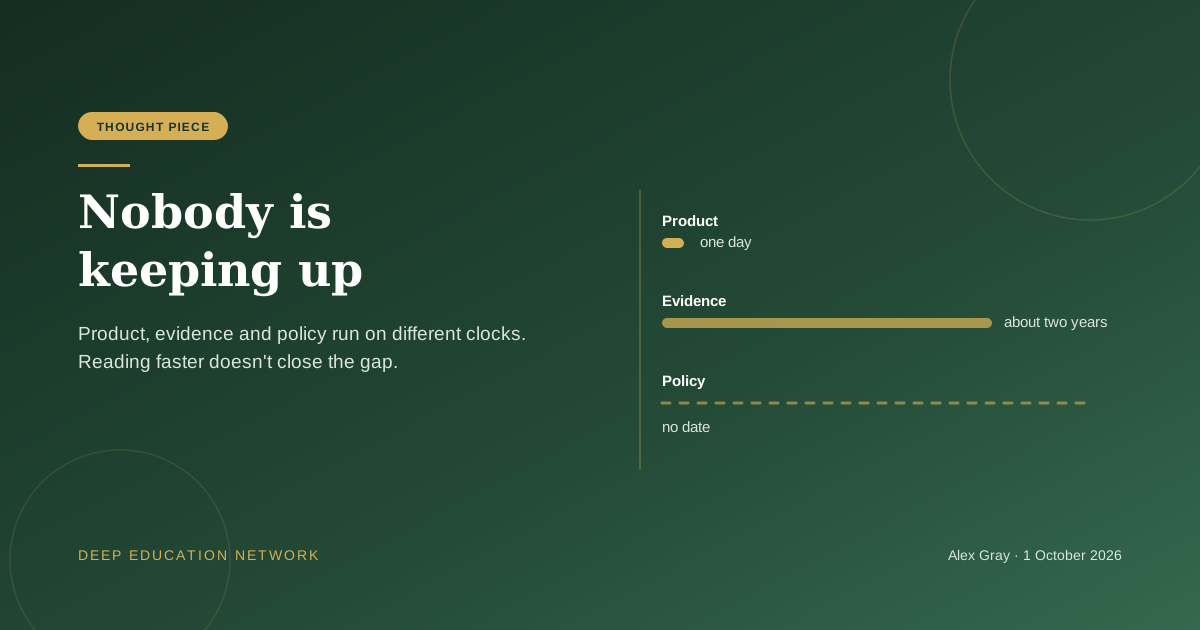
Products ship daily. OpenAI did a year's worth on Tuesday and Google did Gemini 4 on Wednesday, and there'll be another before this term's out.
Evidence takes about two years. The biggest study we have on generative AI and attainment followed 26,811 Chinese secondary students for thirty months, and I wrote it up on Monday. The short version is that homework marks went up, exam marks went down, and the full penalty took about two years to show. That paper was published on 2 June, and as far as I can tell almost nobody in education noticed it for four months. The industry shipped a great deal in that time.
The EEF is running a controlled trial of Aila, a purpose-built AI lesson-planning tool, at the moment. It's 86 schools over ten weeks, and instead of asking teachers afterwards how long planning took, they've had them log it in a weekly diary, with NFER doing the evaluation. Delivery finished in autumn 2025 and the results are due this autumn. That's three years from designing the trial to getting an answer.
And policy, here at least, has no timetable at all. The UAE Cabinet extended the national AI curriculum to private schools on 2 September. It's now been a month and Dubai's regulator hasn't published a start date, a lesson allocation or a route for fitting it into British, IB, American or Indian programmes. So schools have been writing their own age thresholds in the gap, and whenever the circular does come it'll have to be bolted onto all of those.
Nobody designed this. It's what you get when a company, a research funder and a ministry all have a say in the same classroom and none of them works to the others' calendar. The gap between what exists and what we know works is built in, and it isn't going to close because we read faster.
Is it doing more harm than good
I don't think the models are the harm. A model that gives feedback on a hundred pieces of writing in the time a teacher does eight is useful, and saying otherwise to sound careful doesn't help anyone.
The harm's somewhere else, and the CEPR data shows where if you read past the headline. The damage sat with the roughly 80 per cent of AI users who were outsourcing homework, which the researchers spotted as very short completion times paired with high scores. Students who used AI but kept normal completion times showed small losses. So the mechanism isn't exposure, it's substitution for the effortful bit. That makes it a task-design problem, and task design is something teachers already know how to do.
Then there's the pace story itself. When a school leader believes they're permanently behind, they make worse decisions. They buy something to feel current, roll it out to a year group they haven't thought about, and skip the DPIA because the tool's free and half the staff are on it already. The ICO audited 28 edtech suppliers and came back with 596 recommendations, and most of them were the same few things: suppliers calling themselves processors when they're really controllers, thin contracts, nobody having mapped where the data goes, and no DPIA. That's what it looks like from the regulator's side when schools move fast because they feel they have to.
I said something to The National on Monday that I'll say again: the real risk isn't that AI takes over education, it's that AI takes over the thinking. I meant students outsourcing an essay. It applies just as well to a leadership team outsourcing its judgement to whatever was announced on Tuesday.
How are we meant to keep up
We're not, and I don't think that's the problem it looks like.
Nobody is keeping up. The vendors each track their own lane. The regulators are visibly behind. I'm not keeping up, and watching this is my actual job. If the person whose role includes reading every lab announcement can't stay on top of it, then a Head of Maths with a full timetable and a Year 11 intervention group was never going to.
I think we've confused keeping up with the industry with keeping up with our own decisions. The baseline for a teacher isn't knowing every model and every feature, it's knowing what the thing is, where it fails and what your obligations are. Trying to keep up with the industry never ends, and I'm not sure it's ever got me anything. Keeping up with the decisions my school actually has to make is a much smaller job. In a school there are maybe four or five decisions a year that genuinely turn on what the labs have done. Two days of launches from the two biggest labs gave me one.
Four questions
When something new lands, I run it through these. Most announcements fall at the first one, which is the point of having it first.
- Can a student or a teacher in my school reach this today without me doing anything? If yes, it's already a safeguarding and academic integrity question and I need a position this week. If it's behind an admin toggle I've got time to think, and the toggle is my decision to make on purpose.
- Does it change what a student can hand in? That's the assessment question. I ask it about capability, because the tool list changes monthly and the capability doesn't.
- Does it change what the school is responsible for? New data flows, new sub-processors, a supplier quietly becoming a controller. This is the question the ICO's 596 recommendations exist for.
- Is there evidence, and whose is it? A vendor's own study is marketing, whatever the method section says. I'd take one proper trial, with a control group and something like the EEF's diary, over any number of press releases. If there's no evidence yet, pilot it small.
Run Dots through them. It's behind a toggle, so there's time. If it's switched on for students it changes what they can hand in, because it works on its own and comes back with the result. It changes what the school's responsible for, because an agent with its own computer and connections to 4,000 apps is a new data flow however you look at it. And there's no evidence yet, and nothing on the announcement page about under-18s. That isn't a hard call.
Run Gemini 4 through them and it falls at the first question. Nobody in the building can reach it, so there's nothing to decide until that changes.
If an announcement clears none of those, it's industry news. Read it if you enjoy that sort of thing.
What that leaves
Almost no teacher needs to care about DevDay or Gemini 4, and the ones who feel they ought to have picked up that obligation from somewhere that isn't real. The models themselves are doing more good than people are willing to say. What's doing the damage is the story about the pace, because it pushes schools into decisions faster than they can think them through, and a year group you rushed a decision on doesn't come back round for a second go.
As for keeping up, we don't. We get good at the four questions, and we put the time into whatever did clear them. This week that's one admin setting, which needs a proper answer in the next fortnight. The rest can wait until one of them clears a question.
If you want to see where your school stands on AI literacy, policy and safeguarding, the free DEEP AI Literacy Audit takes fifteen minutes.

Stay in the Loop
Get practical insights about AI in education, new articles, and training updates delivered to your inbox.
No spam. Unsubscribe anytime.
Work With Alex
Looking for hands-on support with AI integration, curriculum design, or teacher professional development? Alex works with schools and organisations worldwide to build practical, evidence-informed approaches to education technology.