
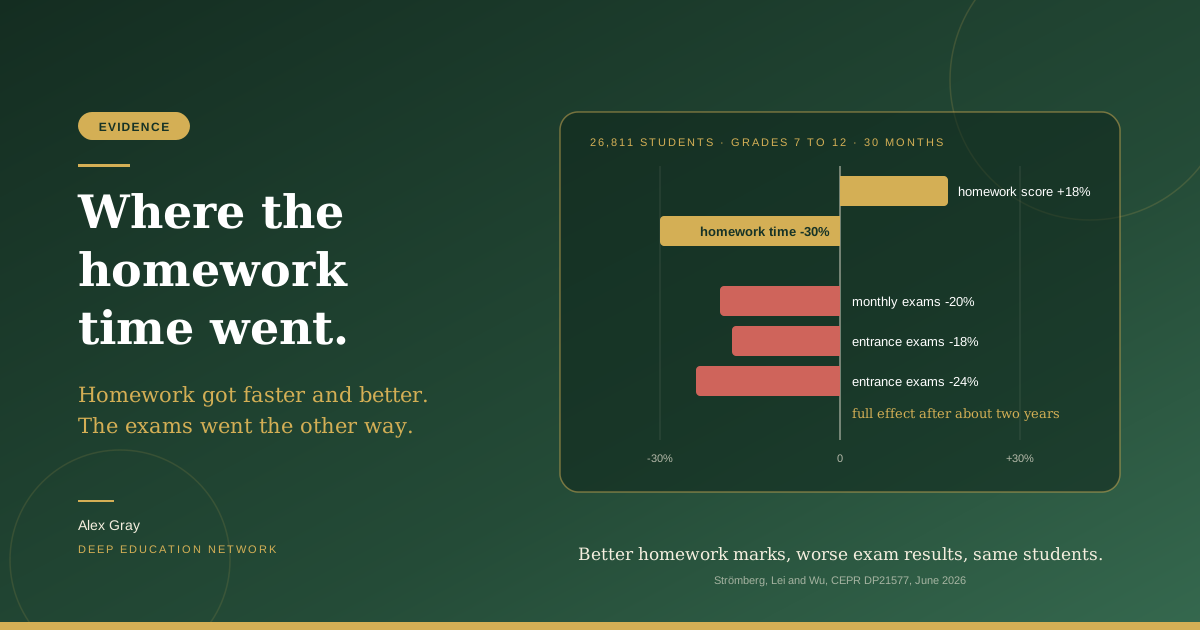
A study of 26,811 secondary students found homework marks rose and exam marks fell after they started using generative AI. The damage came with one visible signature: the time disappeared.
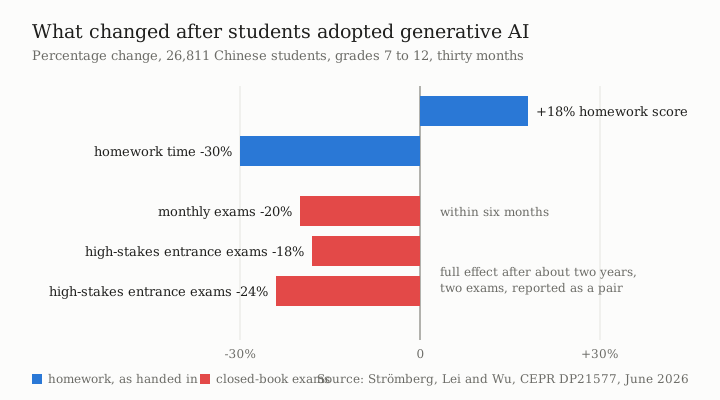
A student's homework scores go up by eighteen per cent. Their exam scores go down by twenty. Both numbers come from the same students in the same subjects, six months apart, and in between they'd started using generative AI.
Those numbers come from a working paper by David Strömberg, Victor Lei and Yanhui Wu, published as CEPR Discussion Paper 21577 on 2 June 2026. I've read a lot of studies on AI and learning this year. Most of them are small, short and run on university students in a course about AI. This one is 26,811 secondary school students in China, grades 7 to 12, followed for thirty months across nine subjects, with monthly closed-book exams and the real high school and university entrance exams at the end, and I don't know of anything bigger.
The data
The reason the study works is the data. Chinese schools run a monthly closed-book exam in every subject, and the platform the researchers used logged homework scores and homework completion time for every student, every night. So they could see how well the homework was done, how long it took, and what happened when the same student sat down without a device.
Students started using the AI tool at different times, which let the authors compare each student with themselves before and after, and with classmates who hadn't switched yet. That's a difference-in-differences design, which is a good way to do it, though it leaves a gap. Nobody was randomly assigned. If the students who reached for the tool first were already drifting, some of the drop belongs to the drift, and the paper can't fully separate the two. It's also a working paper, so it hasn't been through peer review, and it's China, where a single entrance exam decides more than any exam does in the UK or the UAE.
Eighty per cent of the users, one pattern
If we only look at the average we miss who actually got hurt. The authors split the AI users by how they behaved on homework. Roughly eighty per cent of them showed the same signature. Their completion time collapsed and their homework scores jumped, at the same time. The paper describes that as homework outsourcing, and these are the students who took nearly all of the loss.
The other twenty per cent used the tool but kept taking roughly as long as everyone else, and their losses were small.
The drop in time is where the damage was, and I'd put that more plainly than the paper does. If a fourteen-year-old's maths homework used to take forty minutes and now takes twelve, and the marks went up, the marks are the wrong thing to be pleased about.
Who lost most
Three findings here cut against what most of us assume.
In this sample it was the strong students who dropped furthest. The usual line is that strong students will use AI well and it's the weaker ones who need protecting from it, and that isn't what happened here.
Younger students lost more than older ones, and boys lost more than girls. The paper doesn't explain the second of those, so I won't guess.
By subject, social sciences took the biggest hit, then STEM, then languages. That's the order you'd predict if the cost is in the reading, explaining and arguing that homework used to force, and the AI now does instead.
A pilot wouldn't catch this
The monthly exams dropped twenty per cent within six months. The entrance exams fell by eighteen and twenty-four per cent, and the full effect only showed after about two years.
Think about what that does to a school running a trial. You license a tool in September, look at homework completion and marks by Christmas, and see both improve. You look at the mocks in the spring and see a dip you can put down to anything. The real cost turns up two years later, in the exam that actually counts, and by then those students have left. No evaluation any of us has run is long enough to catch it.
What I'd do with this
The bit I keep coming back to is the time. The homework got quicker and the marks went up at the same moment, and you can see that in any school that bothers to ask how long the homework took.
Most schools, including ours, measure homework by the work that comes back. We don't ask how long it took. That's the number these researchers used to spot who was in trouble, and we just don't collect it.
It's also why I don't read this as a case for a ban. New York City put a one-year moratorium on student-facing generative AI through eighth grade this month, announced on 2 September, and I understand the instinct. But the twenty per cent in this study who used the tool and kept their time were fine, more or less. What did the harm was a way of working, and students take that home with them whatever the school allows. The time is the part you can manage, and you can manage it whether the tool is allowed or not.
So here's the one thing I'd try, at department level, before anyone rewrites a policy. Pick one subject and one year group. For four weeks, every piece of set homework asks the student to write how long it took, in minutes, at the top. Treat it as a habit rather than a rule. Then look at the pairs. Time down, mark up. Those are the students to talk to first, and the conversation is about how they got there, not whether they used AI.
It costs nothing and needs no software, and after a month you'd have a list of names. Whether that leads to a homework redesign is a bigger question. But you can't redesign homework until you've looked at how long it takes, and right now almost none of us are looking.
Source: Strömberg, D., Lei, V. and Wu, Y. (2026), "The Generative AI Learning Penalty: Evidence from Chinese Secondary Education", CEPR Discussion Paper DP21577, 2 June 2026. Every figure in this piece is taken from the published abstract.
If you want to see where your school stands on AI literacy, policy and safeguarding, the free DEEP AI Literacy Audit takes fifteen minutes.

Stay in the Loop
Get practical insights about AI in education, new articles, and training updates delivered to your inbox.
No spam. Unsubscribe anytime.
Work With Alex
Looking for hands-on support with AI integration, curriculum design, or teacher professional development? Alex works with schools and organisations worldwide to build practical, evidence-informed approaches to education technology.