
After AI-assisted work, change one condition relevant to the subject. A proposed physics follow-up can help teachers see what students understand and what to reteach.
Students in a Malaysian data-mining course can use Gemini in Google Colab to help produce their models. Their lecturer then asks them to defend their decisions, troubleshoot and spot recommendations that may be wrong. In her account published by Google on 5 October, Nurfadhlina Mohd Sharef describes replacing traditional coding tests with these conversations at Universiti Putra Malaysia.
It's one lecturer describing what she does at a university, on Google's own website. It gives us an approach to examine, without establishing that it improves learning or works across school subjects.
The useful next step is to change something in the problem. Can the student adapt their explanation when a condition changes? That gives us another piece of evidence about the subject knowledge behind the work they've submitted.
An interview might suit a coding course. For a secondary class, I'd start with the learning objective and design a short follow-up that everyone can attempt within the lesson.
Keep the thinking after the feedback
Reading an AI answer is the start of a teaching activity. Students still need to debate its accuracy, consider possible bias, and decide whether a suggestion belongs in their work. Checking a citation can help, but a traceable statement can still be irrelevant to the task or used badly in an argument.
A Frontiers in Education perspective published on 8 October makes a useful distinction. Evaluating feedback means judging its quality and deciding what to do with it. To know how well we've understood something, we need to compare what we think we know with work someone has assessed independently. Agreement with the AI can't supply that comparison.
The article proposes a feedback cycle for higher education and says it needs empirical testing. For a school task, we can ask what happens after the student accepts a suggestion. What could they now attempt that would let us check their understanding?
Change one condition in a physics task
Here is a constructed secondary-school example, proposed for a formative lesson. It hasn't been tested in a class.
The objective is to calculate acceleration from resultant force and mass, and explain how those quantities relate.
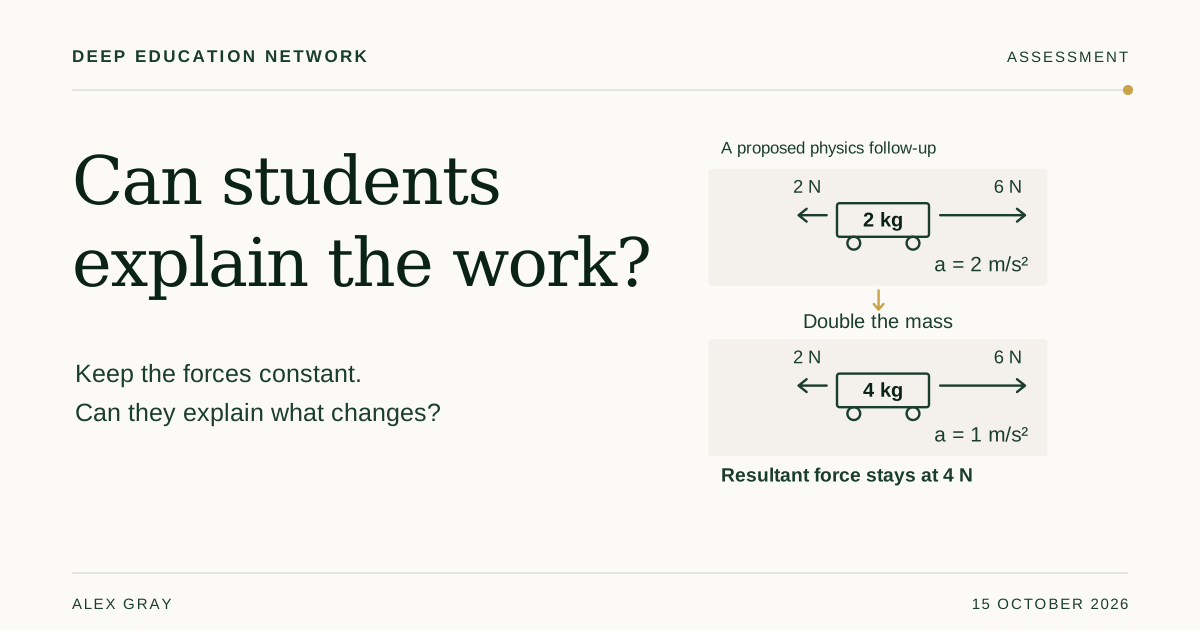
A six-newton force pushes a two-kilogram trolley forwards. Resistance acts backwards with two newtons. Students write an initial explanation of its acceleration, then use AI to question their reasoning or suggest improvements. Combining the forces gives a resultant force of four newtons. Dividing that by the mass gives an acceleration of two metres per second squared.
Keep three small pieces of the work: the initial explanation, one AI suggestion that affected the answer, and the student's reason for accepting or rejecting it. A complete chat transcript would add a lot of reading without being necessary for this exercise.
Then give everyone this follow-up, without AI:
The trolley is loaded so its total mass is now four kilograms. The forward force and resistance stay the same. What happens to its acceleration? Explain your calculation and identify what stayed constant.
The resultant force remains four newtons. With twice the mass, the acceleration becomes one metre per second squared. A student might give the correct figure because they remembered to halve it. Ask them to show how the opposing forces enter the calculation and why the new mass changes the result.
This also makes the student's feedback decision easier to discuss. Suppose the AI suggested using the six-newton push directly in the calculation. The student needs to explain why that leaves out resistance. If they accepted the suggestion, the follow-up gives us a specific misconception to teach again.
Choose a change the objective can support
The principle predates generative AI. The National Research Council's 2000 chapter on learning and transfer discusses using similar cases and changing parts of a problem to help students apply underlying principles. It also cautions against judging transfer through a single attempt. Students may need a prompt or further teaching before they can apply what they know in another situation.
Keep that in mind when choosing the follow-up. The physics objective stays the same. If we add unfamiliar vocabulary, another formula and several new variables at once, a wrong answer becomes difficult to interpret. We could end up reteaching forces when the student needed help reading the question.
In the trolley example, a student who struggles could first be asked to identify the forces acting. Note that help, then offer another example after teaching. One unsuccessful response tells us where to look next; it doesn't settle what the student is capable of learning.
Keep the trial manageable
Try this with one task in one class. Allow roughly ten minutes for the follow-up and discussion. Before extending it, review a small sample and record how much preparation and checking it took. If the notes aren't helping us decide what to teach next, adding more documentation won't make the exercise useful.
A short written explanation, an annotated force diagram with the calculation, or a brief spoken response can show the same physics. Each still needs to account for both forces and the changed mass. If speaking makes it harder for a student to show their physics, let them write it or draw it instead. This objective doesn't require fluent public speaking.
Use the responses to plan feedback and reteaching. This proposed exercise can't establish who wrote the original submission, and it makes no recommendation about graded coursework or qualification rules.
If several students use the push as the resultant force, the next lesson needs work on combining forces. If they can calculate but can't explain why the acceleration changes, that relationship needs more attention. Those findings would justify the teacher time spent on the follow-up and give students something specific to work on next.

Stay in the Loop
Get practical insights about AI in education, new articles, and training updates delivered to your inbox.
No spam. Unsubscribe anytime.
Work With Alex
Looking for hands-on support with AI integration, curriculum design, or teacher professional development? Alex works with schools and organisations worldwide to build practical, evidence-informed approaches to education technology.